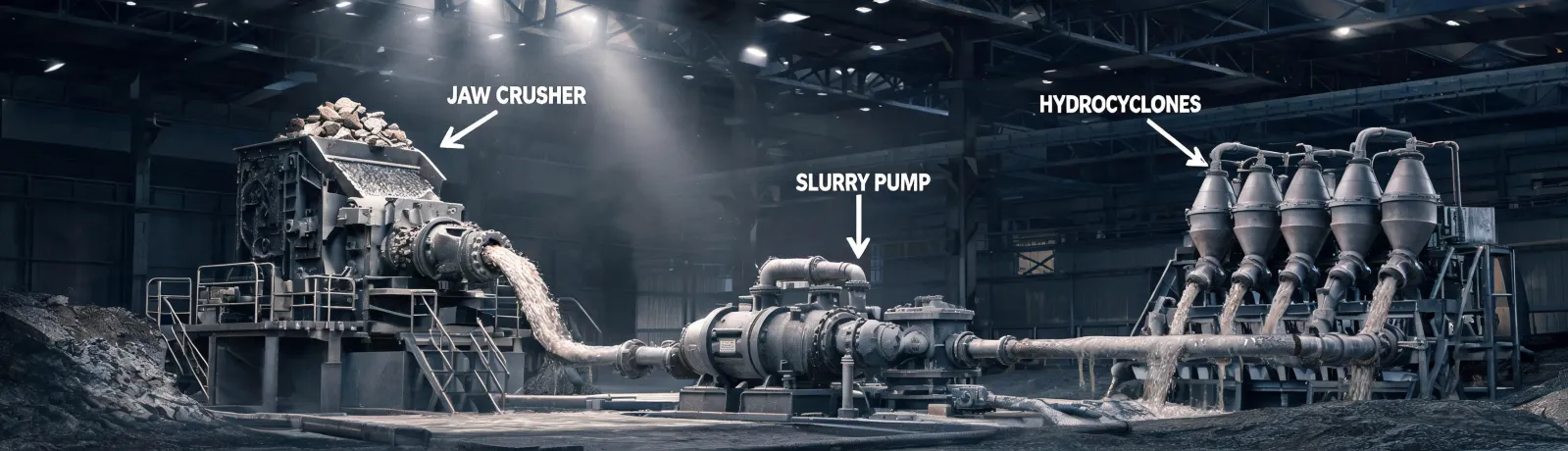
When a critical slurry pump fails on a Thursday afternoon, and the plant manager is staring down a weekend shutdown, you have exactly two options. You order the standard replacement and pray, or you pay the premium for the rush and hope it actually shows up in time.
Most people think this is a simple cost vs. time trade-off. It's not.
In my role coordinating emergency equipment for mining and minerals operations, I've handled over 200 rush orders in the last four years, including same-day turnarounds for clients who had no Plan B. The assumption is that rush orders cost more because they're harder. The reality is they cost more because they are unpredictable and disrupt planned workflows. The causation runs the other way.
Here's how the real comparison breaks down across three dimensions that most procurement guides gloss over.
Dimension 1: Certainty vs. Speed
This is the first trap everyone falls into. They think they are buying speed. They are actually buying certainty.
Standard delivery for a heavy-duty Weir slurry pump (say, a Warman model) from a distributor is usually 3 to 7 business days. The quote says 'estimated'. That 'estimated' is doing a lot of work. It doesn't include the day the trucking company decides to consolidate loads, or the afternoon the warehouse loses the pick ticket.
Rush delivery, on the other hand, quotes a specific time window. “We will have it at your gate by 10 AM Thursday.” That guarantee comes with a price tag—often 25% to 40% more on the base cost, plus air freight—but you are paying for the promise, not just the transport.
In March 2024, 36 hours before a scheduled maintenance shutdown, a client called needing a specific valve actuator. Standard delivery was four days. The alternative was a $50,000 penalty clause for the downtime. We found a vendor with the part in stock, paid $800 extra in rush fees on top of the $4,500 base cost, and had it flown in. The client's alternative was losing that contract.
So glad I pushed for the rush quote immediately. Almost tried to make the standard work to 'save' money, which would have meant missing the deadline entirely.
Dimension 2: The Hidden Risk of 'Good Enough'
The second dimension is about feasibility. Can you actually make a standard part work in an emergency?
People think that a pump is a pump. That an Elvie pump (meant for a completely different context) or a generic well pump can be 'made to work' in a slurry application if you just need flow. Actually, that assumption causes more failures than almost anything else.
I assumed 'same specifications' meant identical results across different pump types. Didn't verify. Turned out each had slightly different interpretations of 'durability.' A standard centrifugal pump designed for clean water will fail catastrophically in a heavy slurry application because the impeller isn't designed for particle abrasion. The assumption is that any pump moves fluid. The reality is that the wrong pump destroys itself and your piping.
This is where the expertise boundary comes in. A vendor who says, “We don't stock a standard version of that slurry pump, but let me see what we can do” is honest. The vendor who says, “Oh, this pump will be fine for that” without asking about the solids content or the specific gravity is dangerous. The vendor who said 'this isn't our strength for a 90% solids slurry—here's who does it better' earned my trust for everything else.
Dimension 3: The True Cost of Disruption
Most cost comparisons stop at the invoice price and the rush fee. They ignore the cost of disruption to your own team.
When I'm triaging a rush order, the part cost is less than 50% of the actual impact. A standard order goes into a queue. It gets processed when the warehouse gets to it. It doesn't require a phone call to the plant floor to pull a mechanic off a scheduled job. It doesn't require the purchasing manager to submit an emergency PO approval at 4:55 PM.
A rush order does all of that. It pulls resources from planned work. Based on our internal data from 200+ rush jobs, the hidden cost of disruption—internal man-hours spent coordinating, expediting, and stress—adds roughly 15% to the total cost of the emergency, even before you pay the rush premium.
I knew I should have flagged the potential for a rush order earlier in the project, but thought 'what are the odds we'll need it?' Well, the odds caught up with me when the standard part arrived with a manufacturing defect ten days later, and we had to scramble for a rush replacement anyway. We paid $800 extra in rush fees, but saved the $12,000 project. Dodged a bullet when I finally approved the emergency PO. Was one click away from authorizing a standard order again, which would have meant missing the client's deadline entirely.
The Selection Framework: When Each Option Wins
So, how do you decide? It's not about picking a 'winner.' It's about matching the decision to the stakes.
Choose the Standard (Estimated) Route When:
- You have at least a 2-day buffer in your schedule
- The failure is in a non-critical or redundant line
- You have a verified spare in stock (never assume you do—check first)
- The cost of disruption to your internal team is low (i.e., you're not pulling people off a weekend)
Choose the Rush (Guaranteed) Route When:
- A specific deadline comes with a penalty (financial or relationship)
- The failure stops production entirely
- You need the certainty more than the lowest possible price
- The standard 'estimated' delivery has failed you before (note to self: track your vendors' on-time rates)
The worst decision is the one you make without asking: 'What's the actual risk of the standard delivery being late?' If that risk is high, you're not paying for speed—you're buying insurance. And insurance is always cheaper than the accident.