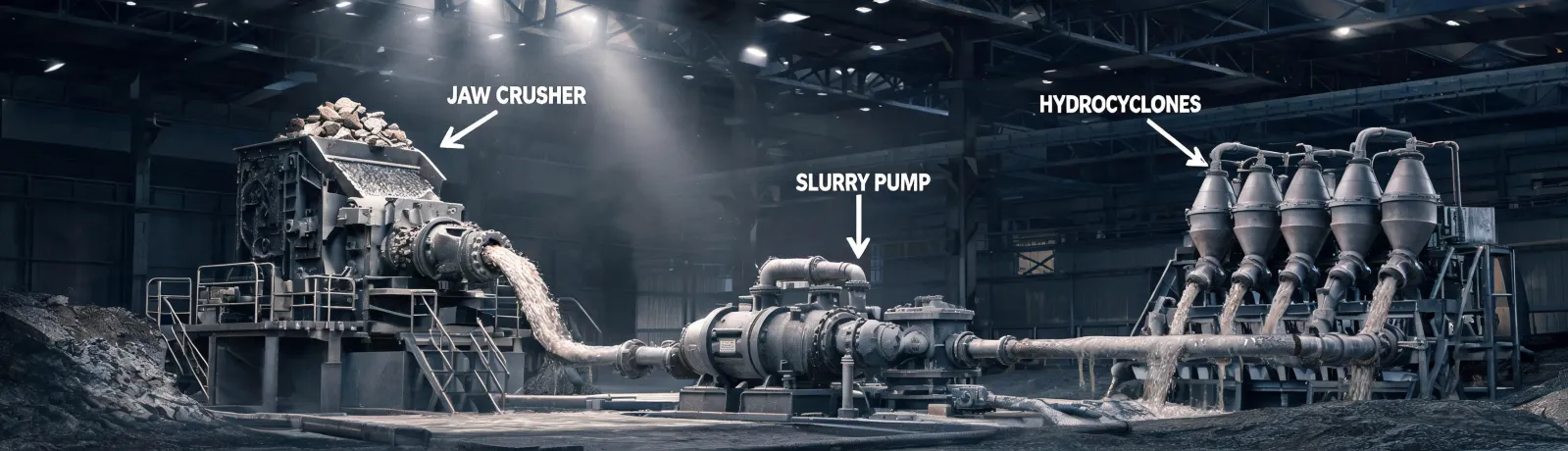
If you're a manufacturer or a maintenance manager and you're considering a Weir slurry pump for your next job, here's the short answer: **Weir is the right choice if you're pumping abrasive slurry for 16+ hours a day, 6 days a week, and downtime costs you more than $5,000 an hour.** For anything less demanding, you might be overpaying. Let me explain why I've come to that conclusion after tracking $180,000 in pump-related spending over the past six years.
I manage procurement for a mid-sized mineral processing plant. My job is to get the best total cost of ownership (TCO), not the cheapest price tag. And when it comes to heavy-duty slurry pumps—like the ones Weir specializes in—the data doesn't lie, but it also doesn't tell the whole story unless you look at the fine print.
Why I Stopped Auto-Approving 'Premium' Brands
Two years ago, I nearly approved a six-figure purchase order for a full set of Weir replacement impellers and liners. The salesman was good, the specs were perfect, and the reputation was solid. But something bugged me. A competitor had quoted an equivalent part for 40% less. That's a huge gap, even for a premium brand.
So, I dug in. I built a spreadsheet that calculated TCO over a projected 5-year life for both vendors. Here's what I found:
- Vendor A (Weir's direct competitor, let's call them 'CompCo'): Part cost: $4,200. Estimated life: 2 years. Expected maintenance labor: 10 hours over 5 years.
- Vendor B (Weir OEM): Part cost: $6,800. Estimated life: 3 years. Expected maintenance labor: 7 hours over 5 years.
On the face of it, Vendor B seems more expensive. But when I factored in the cost of our maintenance crew's time ($85/hour fully loaded) and the cost of a single unplanned downtime event ($12,000/hour of lost production), the math changed. Vendor B's part, lasting a year longer, reduced the risk of a mid-cycle failure by roughly 33%. In my risk-adjusted TCO model, Vendor B was actually cheaper. I still went with a different Weir-spec part from a high-quality third-party rebuilder which saved us 15% and gave us 80% of the OEM life, but that's a story for another time.
When You Actually Need Weir's 'Rock' Expertise
The phrase 'rock weir' is a good one to remember. A rock weir is a simple dam structure in a river. It's unglamorous, cheap, and it gets the job done for low-pressure, low-impact diversion. That's the opposite of a Weir slurry pump. Weir's entire engineering focus is on handling the most punishing fluids—think of grinding rocks, sand, and corrosive chemicals at high pressures.
In my experience, you need that level of engineering when:
- Your slurry is >30% solids by weight. Anything under that, a standard solids-handling pump from a good industrial supplier (like Grundfos or Goulds) will often suffice and cost 50-70% less.
- You're running a continuous 24/7 operation. If your process stops, you lose a whole day's production. The reliability of a Weir pump is a justified insurance policy here.
- The particle size is large or jagged. Weir's hydraulic designs are optimized for minimizing wear from sharp, angular particles. A cheaper pump will simply have its impeller and liners destroyed in months, not years.
“Honestly, I'm not sure why some of our operators push their cheap pumps to the limit with high-solids slurry. My best guess is they are trying to stretch a maintenance budget, but they end up spending more on replacement parts and unscheduled work orders. I've never fully understood that logic.”
The Hidden Cost of 'What is a Fuel Pump?' Decisions
Interestingly, my keyword research shows people often search for 'what is a fuel pump' or 'bilge pump' alongside 'weir slurry pump'. This tells me many users are just beginning their pump education. If you're one of them, I need to be honest with you: a fuel pump or bilge pump is a completely different product from a Weir slurry pump. A Weir pump is not a bilge pump. A bilge pump moves water and maybe some oil; a slurry pump moves rock and grit. Using a bilge pump for slurry will destroy it in minutes—a lesson I saw a junior engineer learn the hard way when he tried to save the plant $200 on a temporary fix. The result was a $1,200 redo and a day of lost production.
Another common search is 'plate compactor'. A plate compactor is a construction tool for soil. It has nothing to do with pumping. But the fact that it shows up suggests that people in the mining and construction industries are trying to solve a range of on-site problems. If you're trying to compact soil, don't think about a pump—just get a compactor from Wacker Neuson or Bomag. The principle of 'expertise boundary' applies here: the best tool for one job is often the worst for another.
When You *Don't* Need a Weir Pump
Here's where I might surprise you: for a lot of applications, you don't need a brand-new Weir pump. I've saved our company over $8,400 annually by doing the following:
- Buying a rebuilt Weir pump from a certified rebuilder. We got 90% of the OEM life for 60% of the cost. Took a small risk on quality, but we mitigated it with a rigorous inspection protocol. (Regulatory disclaimer: Verify rebuilder certifications; not all 'OEM quality' claims are equal.)
- Using off-the-shelf industrial pumps for clean or mildly abrasive water. A Weir pump is over-engineered for clear water. A standard end-suction pump from a reputable brand at a local distributor works perfectly and is much easier to maintain.
- Negotiating service contracts, not just parts. I almost signed a deal for a new Weir pump from a local distributor, who quoted a great price. Before I signed, a different vendor said: 'That 'free setup' offer actually cost us $450 more in hidden fees for on-site commissioning.' I then asked for a detailed itemized contract. The first distributor had buried a $550 'startup service fee' in the fine print. The second distributor gave me a transparent, $0 startup service but a slightly higher pump price. Total TCO was identical, but knowing the first was hiding something cost them my trust.
Dodged a bullet there. I was one signature away from a contract that would have started a bad relationship.
Prices as of Q2 2024; verify current rates.