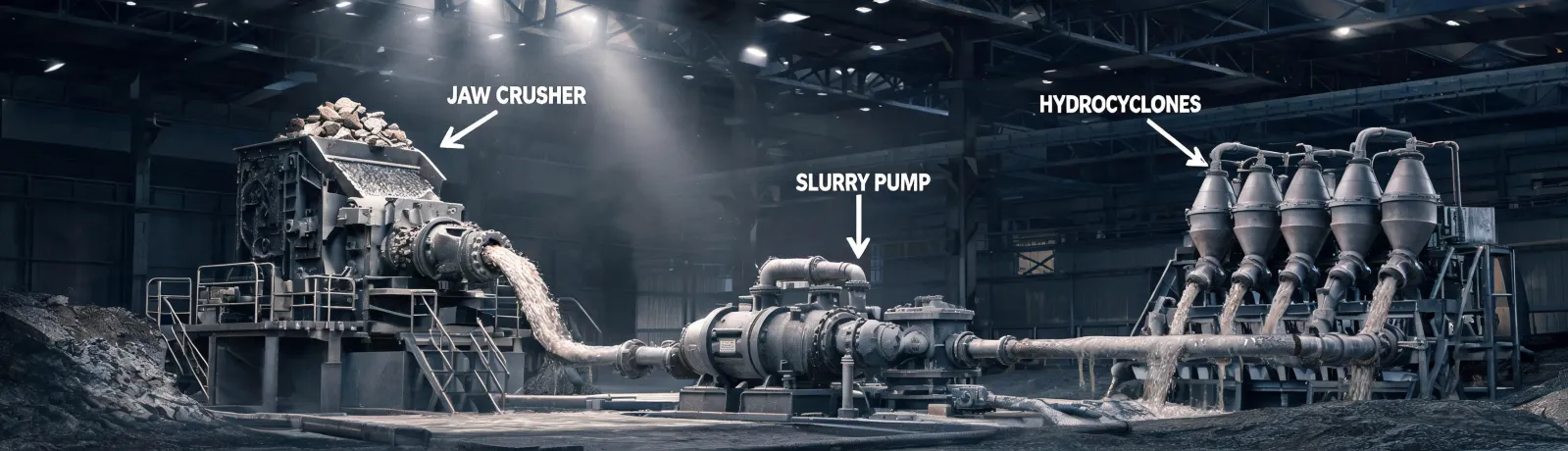
When I first started reviewing pumping equipment specs for our mining clients, I assumed the highest-rated pump was always the best choice. A Weir heavy-duty slurry pump, for instance—I thought, 'That's the gold standard, just go with it.' Three projects where we were way over-spec (and over-budget) later, I realized that matching the gear to the actual slurry characteristics matters a lot more than just picking the toughest name brand.
Here's what I've found after scanning about 200-plus unique equipment specs yearly for compliance. There's no one-size-fits-all. The right pump depends on what exactly you're moving, how often, and at what pressure. So let's break it down into different scenarios.
Scenario A: The Heavy Lifter (Abrasive, High-Density Slurry)
If you're dealing with coarse solids—like in a mineral processing plant or hard rock mine—the Weir slurry pump is a solid fit. The hydraulic design and heavy-duty wear liners in models like the Warman® AH series are built for exactly this. The thick metal casing can handle particles that would tear through a standard trash pump in days.
I recall a Q3 2023 review for a copper mine expansion: they needed to move 2,000 gallons per minute of slurry with 60% solids. The quoted life of a standard pump was 6 months. Double-weir Warman? Between 24 and 36 months between major rebuilds. That's a massive total cost of ownership difference, even if the upfront price is higher (which it is—expect $15,000 to $40,000 for a decent sized Warman unit versus maybe $5,000 to $10,000 for a generic equivalent). The downside is weight and maintenance complexity. You can't just swap a wear plate with a screwdriver. But for continuous duty, it's the right call.
Scenario B: The Generalist (Light Slurry or Clean Fluids)
Now, this is where most people make the mistake. If you're just pumping stormwater runoff, or a light sludge from a settling pond, or even just clean water for cooling—a heavy-duty Weir is overkill. That added weight, cost, and power draw are wasted.
For these jobs, a standard end-suction centrifugal pump or even a submersible pump does the job fine. I've approved equipment for a sand-and-gravel operation that used standard vertical turbine pumps for dirty water—it worked for 4 years with just basic seals replaced. Spending $25,000 on a Weir pump for that same task would have been a budget mistake. Plus, the service infrastructure for a simpler pump is easier and cheaper.
Here's something vendors won't tell you: the Weir pump is designed for sustained abrasive contact. Running one on clean water actually reduces its efficiency and can be a waste of a high-quality piece of engineering. It's like using a monster truck to drive to the grocery store. You can do it, but it's not the best tool for the job.
Scenario C: The 'Rock Weir' Confusion
A quick sidebar for the civil engineers who might have landed here looking for 'rock weir.' That is a completely different thing—a stone structure in a stream to control erosion. Totally separate field. If you're designing a channel for water control, the pump brand is not your concern. But I've had three instances where someone ordered a pump thinking it was for a rock weir project. Just a heads up.
How Do You Know Which One You Are?
To figure out which scenario fits, ask yourself three questions:
- What is the solids concentration? Above 10-15% suspended solids by weight? That's slurry territory. Less than that? A standard pump might be fine.
- What is the particle size and shape? Sharp, angular material (like crushed ore) wears down impellers fast. A Weir pump's wear life is significantly better here.
- Is this continuous or batch duty? If the pump runs 24/7 for years, the premium for durability pays off. If it runs for an hour a week, it doesn't.
I can only speak to what we've observed in the mining and aggregate sectors. If you're dealing with chemical processing or food-grade slurries, the material compatibility considerations change everything. My experience is limited to abrasion-focused applications.
Ultimately, I've rejected more proposals for being over-engineered for the job than being under. Don't be the guy who buys a Formula 1 engine for a bicycle. The Weir pump is a fantastic tool—just make sure the tool fits the job.