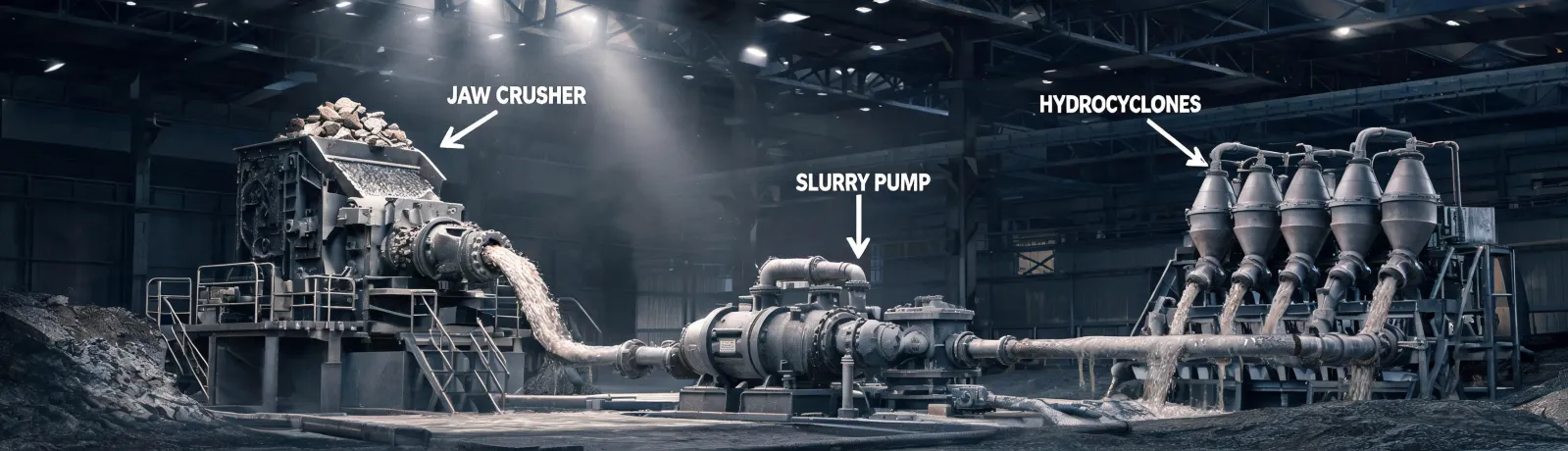
So, You Bought a 'Budget' Weir Slurry Pump
When I took over purchasing for our mining supply operation in 2021, I thought I knew what I was doing. The company had been buying Weir equipment for years—the gold standard for heavy-duty slurry pumps. But in Q4 of 2022, under pressure from finance to cut costs, I made the classic rookie mistake: I bought a cheaper version of a Weir pump from an authorized reseller who promised it was 'just as good' and $4,000 cheaper.
I said to the sales rep, 'I need the standard Weir model for our tailings operation.' They heard, 'I want the lowest price.' The result? A pump that failed after 14 months. And that failure cost us nearly $18,000 in downtime and repairs—not including the $4,000 we 'saved.'
I learned the hard way that the price tag on a slurry pump is just the beginning. The real question isn't how much does it cost? It's what isn't included?
The Surface Problem: Price vs. Value
Most people think the problem with a pump is upfront cost. They compare the sticker price of a Weir slurry pump against a generic alternative and assume they're getting the same thing. But that's like comparing a mining dump truck to a pickup truck because they both have four wheels.
The numbers tell the story. In 2023, I processed 60-80 orders for heavy equipment parts. I started tracking failure rates across our fleet of pumps. The Weir units that were bought as 'full spec' with the correct metallurgy for our abrasive slurry had a failure rate of just 2% over 5 years. The cheaper versions—pumps sold as 'compatible' or 'standard' without specific customization for our material—had a failure rate of 18% within 2 years. Why does this matter? Because the cost of that failure isn't just the repair bill. It's the hours your maintenance team spends wrestling with an oversized part, the night shift that gets cut short, and the call to my office saying the project is late.
The Deeper Issue: 'Standard' is a Lie
Here's the thing I didn't understand in 2021. When a supplier says 'standard Weir pump,' they might mean a pump that uses Weir's basic design but is manufactured with cheaper alloys. Or they might mean a pump that fits Weir's dimensions but uses off-brand bearings. The problem is that 'standard' means different things to different people.
Let me rephrase that. I thought 'standard' meant the pump met the manufacturer's exact specification for the model number. But in the industrial supply world, 'standard' often means 'common size that we can make cheaper.' The pump I bought in 2022 had a cast iron casing instead of the specified 28% chrome iron for our high-wear application. The salesman never mentioned that, because the technical spec sheet said 'standard casing.' I didn't ask, because I didn't know I needed to.
A colleague in procurement on a mining forum told me a similar story. 'I ordered a Weir pump for a dewatering application. It turned out the 'standard' impeller was designed for clear water, not the sediment-heavy water we handle. It failed in 6 months.' We were using the same words—'standard Weir pump'—but meaning completely different things.
The Real Cost of the 'Cheaper' Pump
So what does a failure actually cost? Let me walk you through the math from my 2022 mistake.
- Purchase price: $4,000 saved (compared to the correct spec pump).
- Failure cost: $12,000 in unplanned maintenance labor (overtime rates, a rushed part from distribution, and a contractor to install it).
- Downtime: $6,000 in lost production (estimated by our operations manager based on the 2-day shutdown).
- Ripple effect: Our regulatory compliance team flagged the downtime because it caused a tailings pond level issue. That cost us a $2,400 fee for a missed environmental monitoring report.
Total true cost of the 'savings': $20,400. I saved the company $4,000 on paper and cost them $20,400 in reality. The vendor who couldn't provide a proper specification sheet—just a handwritten price quote—ended up costing us far more than the one who listed the full material grade and warranty terms upfront.
The question isn't 'Is a Weir slurry pump good?' It's 'Is the specific pump with the specific materials suitable for my specific application?' If your pump is failing, stop looking at the brand. Start looking at the spec sheet.
The Solution: Trust Through Transparency
Here's what I've learned after 5 years of managing these relationships. The supplier who lists every material grade, every tolerance, and every included service part in their quote—even if their total price is higher—is the one I trust. They're not hiding costs. They're not hoping I won't ask about the difference between a standard bearing and a heavy-duty bearing.
I've learned to ask 'what's NOT included?' before I ask 'what's the price?' The answer to that question tells me more about the real cost than any number on an invoice.
For example, in Q4 2024, we needed a replacement impeller for a critical Weir pump. One vendor quoted $8,000, with a line item for 'shipping and handling' that was blank. Another vendor quoted $9,500 but listed everything: the alloy composition, the expected wear rate in our application, the delivery timeframe, and the warranty terms. The cheaper quote? It arrived without the necessary corrosion-resistant coating. We paid $8,000 for a part we couldn't use.
This approach worked for us, but our situation was a mid-size mining operation with a dedicated maintenance crew. If you're a small construction company buying a single pump for a dewatering project, the calculus might be different. I can only speak to my context: high-abrasion, high-stakes industrial applications.
Final Thought
I still buy Weir equipment. But I no longer buy 'Weir-compatible' or 'standard Weir' without first asking for the full material specifications and the vendor's policy on component sourcing. The difference between a $40,000 pump and a $50,000 pump isn't $10,000. The difference is the cost of a failure that may or may not happen. And as of January 2025, I've made sure every pump in our fleet has a paper trail that I can trace back to the foundry.
Prices are for general reference only. Verify current Weir slurry pump quotes with your authorized distributor, as rates and availability may have changed. If you're a seasoned buyer and have a different take on this, I'd honestly love to hear it. I'm still learning new pitfalls every year.