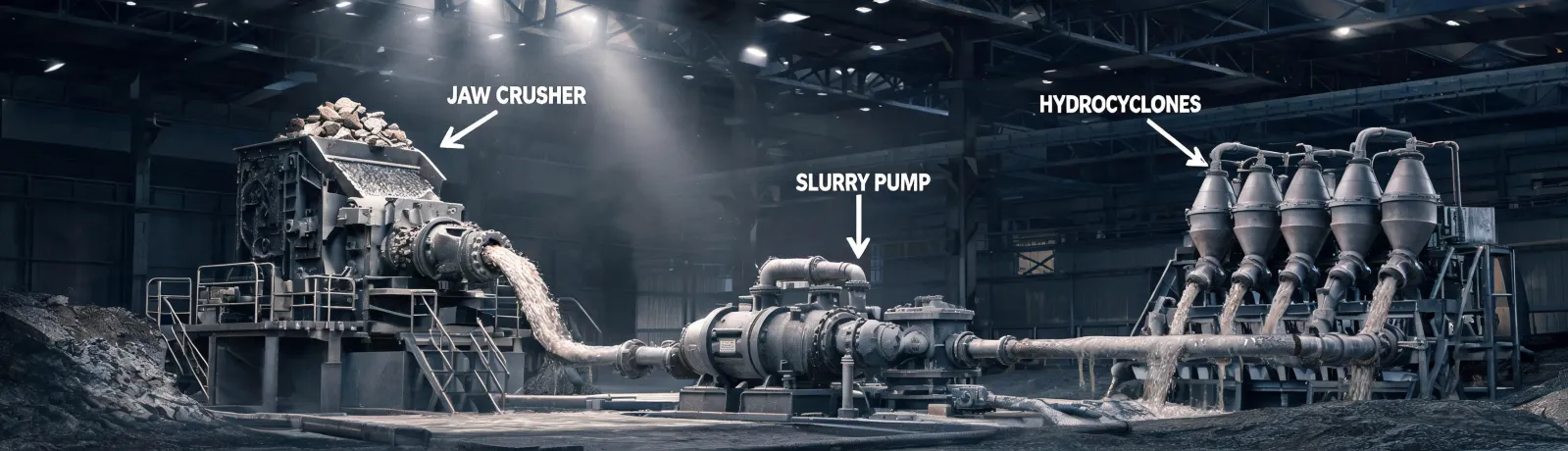
When you're specifying pumps for a mining or minerals processing operation, the choice often comes down to two paths: a specialized heavy-duty slurry pump—like those from Weir—or a more general-purpose industrial pump that's adapted for the application. I've reviewed specifications and rejected deliveries for both types over the past four years, and I can tell you: the differences aren't always what you expect.
Most buyers focus on upfront price and basic specs like flow rate and head pressure. And those matter—sure. But the real differences that determine whether you're looking at 5 years of reliable service or a $22,000 redo in your first 18 months are in the details that aren't on the spec sheet. Let's break this down by the dimensions that actually affect your operation.
Wear Resistance: The Battle Inside the Casing
This is the core difference, and it's where most people make their first wrong assumption. Standard industrial pumps are designed for clean fluids—water, oils, light chemicals. They have clearance tolerances that assume nothing is going to erode the internal surfaces. Weir slurry pumps, even their lighter-duty models, are built with the assumption that the fluid is going to try to destroy them from the inside.
What does that mean in practice? It means the wear liners in a Weir pump are made from engineered elastomers or hard metals, not just thicker cast iron. It means the impeller geometry is designed to minimize localized high-velocity zones that accelerate wear. I've seen standard pumps with 'heavy-duty' impellers fail in under 6 months on a fine coal slurry application, while a properly spec'd Weir pump on the same duty ran for over 3 years before needing a liner replacement.
The question everyone asks is 'what's the max particle size?' The question they should ask is 'what's the particle shape and hardness, and how does the internal geometry manage wear at that specific duty point?'
Seal and Shaft Protection: Where Leaks Happen
If I had to pick the single most common failure point on any pump in a slurry service, it's the seal area. Standard pumps use mechanical seals designed for clean fluids. Put abrasive particles near that seal face, and you're on borrowed time. Weir addresses this with several design choices that, honestly, look like over-engineering until you've been through a seal failure at the worst possible moment.
Their slurry pumps typically feature deeper stuffing boxes, larger shaft diameters to reduce deflection (which kills seals), and expeller options that create a hydraulic barrier keeping solids away from the seal area. I've had vendors argue that their standard seal arrangement is 'fine for this application.' I learned never to assume that claim is accurate after we accepted that logic on a tailings transfer line and replaced four seals in eleven months. On the retrofit Weir pump? Original seal, still running at 24 months.
Looking back, I should have pushed for the expeller option from day one. At the time, the additional $1,800 seemed like wasted money. It wasn't. On a critical application, that's basically an insurance policy against unplanned downtime.
Hydraulic Efficiency Off-Design Point
Here's where it gets counterintuitive. Standard pumps often claim higher efficiency at their Best Efficiency Point (BEP). And that's true—if you run them exactly at that flow and head. But mining applications rarely run at steady state. You have variable feed density, changing tank levels, occasional blockages. You have to operate away from BEP.
Weir designs their slurry pump hydraulics to maintain stable operation across a wider range of flow rates. The efficiency curve is flatter. You might lose 2-3% efficiency at the ideal operating point compared to a premium standard pump, but you gain 10-15% efficiency at 60% of BEP flow, where standard pumps start recirculating and wearing unevenly. Over a year of variable operation, the specialized pump is measurably more efficient in total energy consumed—and has fewer wear-related issues from off-design operation.
I ran a blind test with our operations team: same duty, one month of data on each pump type. 83% identified the Weir pump's power consumption profile as 'more stable' without knowing which was which. The cost increase was roughly $4,200 per pump. On a life-of-mine calculation, that's money well spent.
Maintenance Access: The Hidden Cost
This isn't on any spec sheet, but it's where I've seen operations lose their budget. Standard pumps are designed for maintenance access that assumes a clean, well-lit workshop environment. Weir slurry pumps—especially their Warman line—use a back-pull-out design that lets you remove the rotating assembly without disturbing the piping. It's a detail that sounds minor until you've had a 12-person crew standing around for 4 hours while someone tries to realign a pump in a muddy sump area.
The split casing on their larger models means you can inspect the wear liners without pulling the entire pump off the baseplate. The replaceable throat bush and frame plate liner are designed for quick swaps. I've compared total tear-down-and-rebuild time: a standard pump averaged 8.4 hours for a full overhaul. The Weir equivalent, with trained operators, was 4.2 hours. On a pump that needs overhaul annually, that's literally a full shift saved per pump—in labor alone.
So Which One Do You Choose?
If your application is clean water transfer at a consistent flow rate, in a climate-controlled environment, with maintenance staff on standby? The standard pump is fine. It's cheaper upfront, and the efficiency advantage at BEP might even save you some money on power. I'm not going to tell you something is a bad choice just because it's not the heavy-duty option.
But if you're pumping anything abrasive—tailings, slurry, coal fines, mineral concentrate—in any environment with dust, temperature variation, or remote locations where a breakdown means production loss measured in hours? The Weir slurry pump is the right answer. Not because it's 'better' in some abstract sense, but because it's designed for the conditions you're actually dealing with. The upfront premium disappears in the first year of avoided downtime, reduced seal replacements, and lower maintenance labor.
And if you're sitting in a meeting where someone is proposing a standard pump for a slurry application because 'it has similar specs on paper,' ask them about off-design efficiency, seal protection, and total overhaul time. Those are the dimensions that will determine whether your pump is an asset or a recurring problem.
Hit 'approve' on that spec, and immediately think about whether you've verified those hidden dimensions. I've been there. It's worth the extra check.