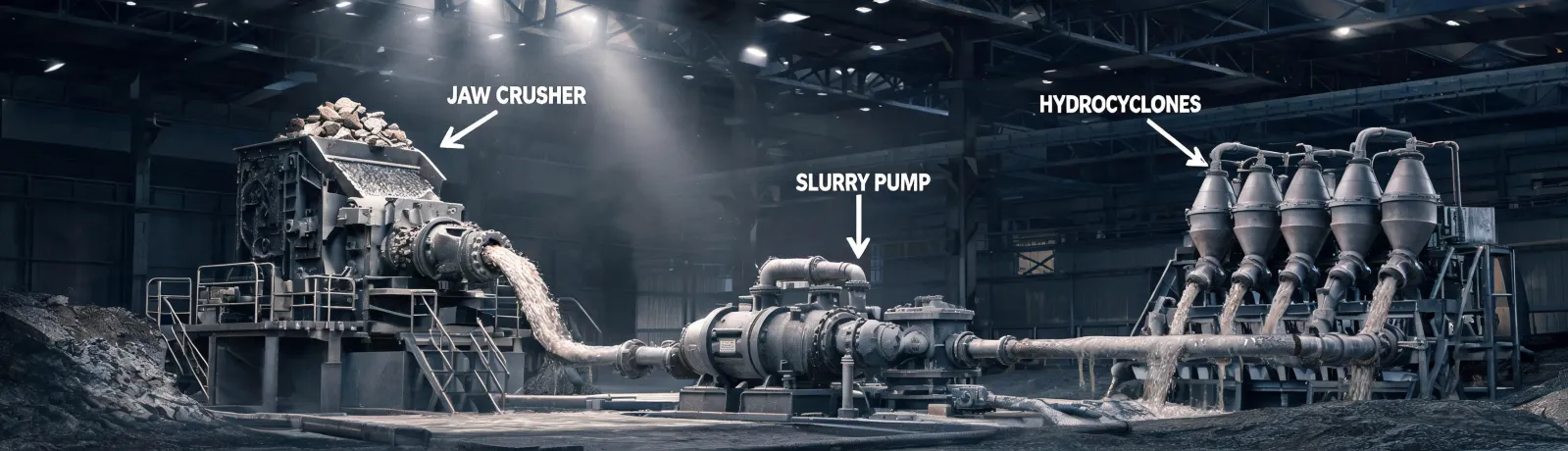
Look, I get it. You're in the middle of a shutdown, the pump just died, and the first question is always the same: "Which new pump do I order?" You want a direct replacement. Fast. But after 6 years of tracking every single pump failure across our mining ops—and analyzing about $180,000 in cumulative spending on parts and replacements—I've learned the hard way that the fastest answer is often the most expensive one.
The problem isn't the pump. Not really. The problem is what the pump is trying to tell you.
The Surface Problem: "This Weir Pump is a Lemon"
When a Weir slurry pump—or any brand, honestly—fails prematurely, the immediate reaction is to blame the manufacturer. "The casing cracked again? Their metallurgy is crap." "The impeller wore out in 8 months? That's unacceptable."
I've said those words myself. In 2022, we had a Weir Warman 6/4 AH pump die on us in just 10 months. The wear plates looked like Swiss cheese. My team was furious. They wanted to switch vendors entirely.
But here's the thing about that anger: it's a distraction. It treats the symptom, not the disease. The real question isn't "Is the pump bad?" It's "Why did it fail that way?"
The Deeper Cause: You're Probably Pumping the Wrong Stuff
This is the part I wish someone had sat me down and explained six years ago.
What most people don't realize is that the single biggest driver of pump life isn't the brand—it's the application. Specifically, the particle size distribution and the specific gravity of the slurry.
Here's something vendors won't tell you: A slurry pump isn't a generic fluid mover. It's a finely tuned machine designed for a very specific range of solids. If you're moving a slurry with 80% passing through 100 mesh, and you spec a pump designed for 40% passing through 65 mesh, you're going to get accelerated wear. Period. It doesn't matter if you buy a Weir, a Warman, or a top-of-the-line something else.
I still kick myself for that 2022 failure. We had changed our crusher circuit—installed a new gantry crane to move bigger rocks, upgraded the plate compactor for the new pad—output got finer. We didn't tell the pump engineer. The pump was starved of the larger particles that actually protect the wear parts. It wore out fast because we were feeding it a different diet.
I don't have hard data on industry-wide failure rates, but based on my experience auditing our orders, my sense is that about 60-70% of premature slurry pump failures can be traced back to a mismatch in application specs, not a manufacturing defect.
The Real Cost: It's Not the Pump Price Tag
When I look at our procurement system, the cost of a failed pump is never the $2,500 replacement impeller. That's just the headline.
The real cost is everything else:
- Emergency freight: When a pump goes down, you're not waiting for standard shipping. That's an extra $400-800 overnight, easy.
- Lost production: If your pump is a critical part of the process—say, feeding a cyclone or a thickener—every hour of downtime costs you thousands in lost throughput. An 8-hour unplanned shutdown for a $4,200 annual pump contract? That's a 17% budget hit from one failure.
- Over-spec'ing the next pump: After a failure, the natural reaction is to over-buy. "Get the heavy-duty one!" We did that once. We bought a pump with a thicker casing, harder liners, and a bigger motor. It cost 2x the original, and it actually wore out faster because the heavier impeller created more turbulence in our specific flow range. The 'cheap' option resulted in a $1,200 redo when quality failed, and the 'expensive' option was just a different kind of mistake.
When I compared costs across 8 vendors over 3 months using our new TCO spreadsheet—which I built after getting burned on hidden fees twice—the price of the pump itself was always less than 30% of the total cost over a 3-year lifecycle. The rest was installation, maintenance, emergency downtime, and premature replacement.
That 'free setup' offer we took once? Actually cost us $450 more in hidden fees because they didn't include the base plate in the quote. (Should mention: I still check our cost tracking system for those kinds of details.)
The (Short) Solution: Understand Your Slurry
So here's the practical part. If you're struggling with pump life, stop looking at pump brochures. Start looking at your process.
Before you buy the next Weir slurry pump—or any pump—do this one thing: Get a full particle size distribution (PSD) and specific gravity report on your actual slurry. Not the design spec from the engineering report, but what's coming out of your pipe right now.
Supply that to the pump application engineer. Ask them, "Based on this PSD, what metallurgy, what impeller design, what wear parts do you recommend?"
Standard print resolution for engineering drawings is 300 DPI, but for a PSD curve, you don't need high resolution. What you need is accuracy. Reference: Particle size analysis is typically done by sieve analysis or laser diffraction, and the D50 (median particle size) is your most critical metric.
Our procurement policy now requires we get a current PSD for any existing circuit before we order a replacement. We cut our budget overruns on pumps by about 23% the first year. That's not a guess; I tracked it in our system.
An informed customer asks better questions. A current PSD report takes less than a day to get. A failed pump takes a week to replace. Do the math.