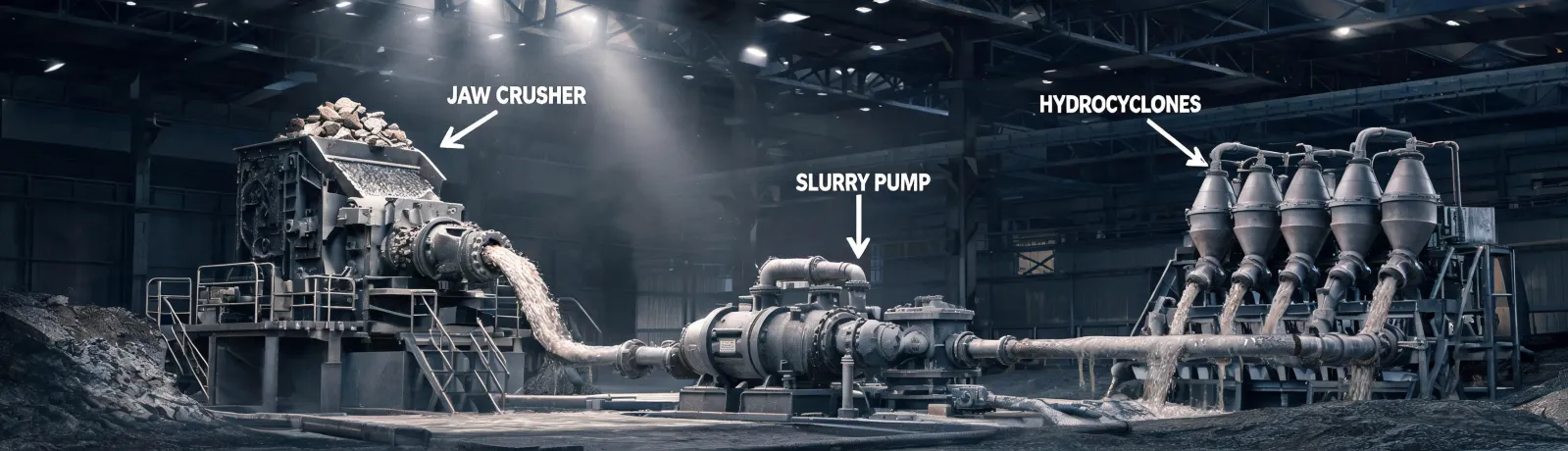
Two Paths to the Same Pump: A Comparison Framework
Over the past seven years of managing a mid-sized mining operation's equipment budget—roughly $2.5M annually in pumps, valves, and wear parts—I've learned that the cheapest quote is often a trap. When you need a slurry pump that can handle 65% solids with a specific gravity of 2.8, the decision isn't just about price. It's about whether your vendor understands the problem.
I'm going to compare two sourcing philosophies: the specialist (like Weir)—a vendor whose core competency is engineered solutions for abrasive and corrosive slurries—and the generalist industrial supplier, who sells pumps for everything from wastewater to chemical transfer. We'll compare across three dimensions: total cost of ownership, risk mitigation, and technical fit.
A quick note on my context: I'm a procurement manager, not a metallurgical engineer. I can't speak to the specific metallurgy of a white iron impeller, but I can tell you what happens to your bottom line when that impeller fails after 400 hours versus 2,000. If you're dealing with a new mineral processing circuit, I'd recommend consulting a process engineer before making a final call. This is a procurement perspective on how I evaluate vendors.
Dimension 1: Total Cost of Ownership (TCO) — Price vs. Performance
The generalist will almost always quote a lower initial price. A standard ANSI pump rated for slurry is cheaper than a Weir Warman® AH pump. That's just math on a commodity. But here's where the 'cost' difference really shows up.
When I analyzed our 2023 spending across eight major pump purchases, I tracked not just the purchase order value, but also installation, power draw, wear part replacement, and downtime. Let me give you a concrete example from Q2 2024:
We needed a replacement pump for a cyclone feed application. Vendor A (specialist, like Weir) quoted $48,000 for a heavy-duty slurry pump. Vendor B (generalist) quoted $32,000 for a 'heavy-duty slurry' model.
Vendor A's pump ran at 85% efficiency. Vendor B's ran at 72%. At $0.12/kWh, over 8,000 hours of operation, the energy cost difference alone was $11,520. Add in the fact that Vendor A's wet-end parts lasted 1,800 hours versus Vendor B's 800 hours, and the replacement part cost (liner & impeller) was $4,200 for A and $2,600 for B.
5-year TCO calculation (based on 8,000 hours/year):
- Vendor A (Specialist): $48,000 (pump) + $18,667 (wear parts/5yr) + $134,400 (energy) = $201,067
- Vendor B (Generalist): $32,000 (pump) + $26,000 (wear parts/5yr) + $153,600 (energy) = $211,600
I almost went with the $32,000 quote until I ran the numbers. The specialist's pump was $10,533 cheaper over 5 years, not including unplanned downtime costs.
The conclusion here is clear: If your application is truly aggressive, the specialist's pump doesn't cost more—it costs less when you look at the operating lifecycle. The generalist's pump is only cheaper if you're selling it, not living with it.
Dimension 2: Risk Mitigation — Engineering Confidence vs. 'It Should Work'
This is the dimension where I've made my biggest mistakes. The most frustrating part of dealing with non-specialist vendors: the same issues recurring despite clear communication. You'd think specifying 'slurry duty, 1200 GPM, 200 ft TDH, pH 4-5' would be enough. But interpretation varies wildly.
I still kick myself for a purchase in 2021. We bought a generalist's 'slurry pump' for our mill discharge. The price was right. But six months in, the shaft started vibrating due to inadequate bearing sizing for the heavy solids loading. Two repairs, three days of downtime per incident. The 'cheap' option resulted in a $12,000 redo when we finally retrofitted it with a specialist's bearing cartridge.
A specialist like Weir doesn't just sell you a pump. They ask about the specific gravity of your slurry, the particle size distribution, the operating temperature, and the required wear life. They then match a pump model and materials to your exact duty cycle. The generalist often says, 'This model handles slurry—it'll work.' One is a fit, the other is a gamble.
Here's something vendors won't tell you: a 'slurry pump' from a generalist catalog may have been designed for light ash handling or stormwater, not mineral processing. It lacks the hydraulic design to keep heavy particles in suspension, leading to accelerated wear and recirculation. The specialist's hydraulic profile is designed from the ground up for high-density transport.
The verdict: If downtime costs you $5,000 an hour (which it did during our peak season last year), the specialist's engineering confidence is worth a premium. The generalist introduces a variable I can't quantify easily: how well will this pump really perform under full load, 24/7?
Dimension 3: Technical Fit — 'One-Stop Shop' vs. 'Best Fit for the Job'
Now, I get why people go with generalist suppliers. Streamlined procurement, fewer vendor relationships to manage, and a single contract. But here's a controversial take: the vendor who says 'we've got everything you need' is either lying or dangerously overextended. I'd rather work with a specialist who knows their limits than a generalist who overpromises.
When we needed a specific valve for a high-temperature, high-pressure slurry line, our generalist supplier couldn't source it. They tried to push a standard gate valve. We ended up getting the wrong part, leading to a 12-hour installation that leaked within a week. A specialist—someone who engineers slurry valves—would have asked about the temperature curve and metal compatibility upfront.
This is where the 'expertise boundary' becomes critical. A reputable specialist will tell you: 'This is our core product. Here's what it's designed for. If your application deviates, we'll tell you what modifications are needed, or recommend a different solution.' A generalist might just say 'we'll make it work' because they're afraid of losing the sale. Trust me, the sales rep's desire for a commission is not the same as your need for reliability.
Key question to ask any vendor: 'What is your specific experience with my type of slurry—copper concentrate, phosphate rock, iron ore tailings?' If they can't give a concrete example from their own product history, I'd be skeptical. I've found that the most effective procurement strategy involves a two-tier system: specialist partners for critical wear-path equipment, and generalist suppliers for non-critical items like sump pumps or standard valves.
So, Which Path Do You Take?
There's no universal 'right' answer, but there is a framework. Based on my experience negotiating with dozens of vendors and tracking every invoice in our cost system, here's how I'd advise a colleague:
Choose the specialist (the 'Weir' approach) when:
- Your application involves high solids content (>30%), large particles, or corrosive chemicals.
- Unplanned downtime carries a significant cost (lost production, safety risks).
- You need predictable wear life for spare part planning.
- You value engineering support for optimization, not just a product catalog.
Choose the generalist when:
- The application is non-aggressive (e.g., clear water, mild chemical transfer).
- You need a simple, off-the-shelf pump for a temporary installation.
- Your budget is extremely constrained and capital cost is the only decision metric.
- You can afford to replace the pump within two years if it fails.
In my experience—and I've made both decisions—the cost of the 'wrong' specialist is small (you pay a premium for a robust product). The cost of the 'wrong' generalist in a demanding application is catastrophic (downtime, rework, plant inefficiencies). For critical slurry handling, I've learned the hard way: don't treat a pump as a commodity. Treat it as an engineered solution to a specific problem. And the vendors who understand that problem are worth their weight in, well, wear metal.
Based on my procurement records and public pricing data (pump costs as of Q1 2024; energy costs vary by region. Always verify current rates).