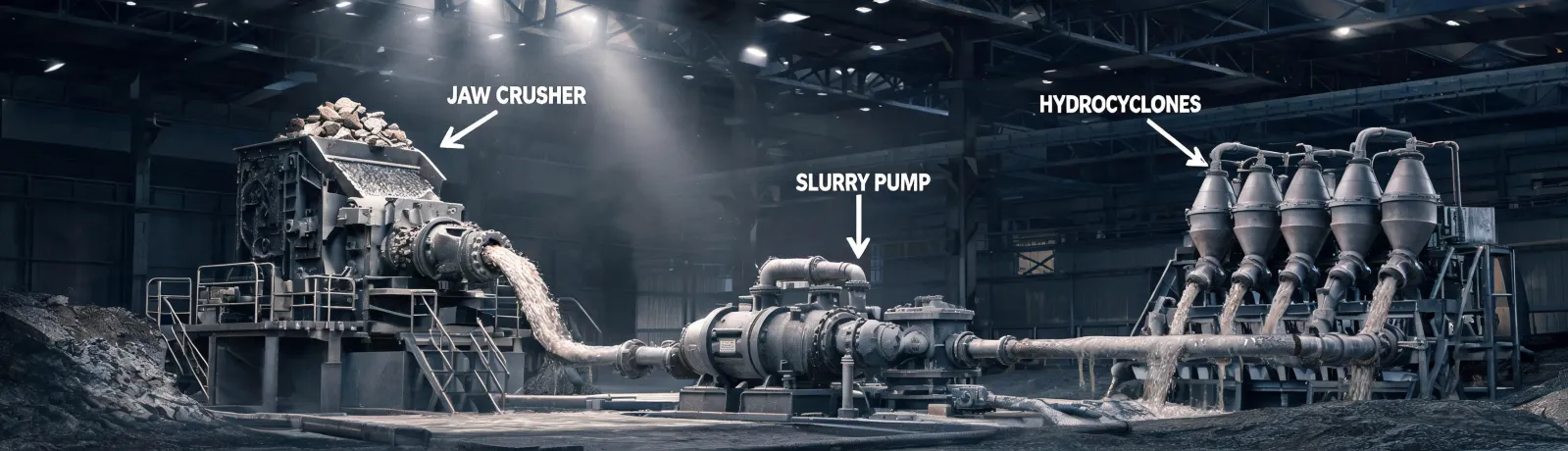
Look, I've been doing this long enough to know that when a slurry pump goes down, everyone's first instinct is to blame the pump itself. I was the same way. For the first few years managing procurement for our mining operation, I'd be on the phone with Weir support, complaining about a 'defective' pump, and the conversation would always circle back to the same thing: the hose.
It took me about 40 failed orders (and a very uncomfortable meeting with my VP) to finally get it. The pump wasn't the problem. The hose was the bottleneck. And I'd been ignoring it.
The Problem I Thought I Had: 'The Pump Is Unreliable'
When I took over purchasing in 2020, our Weir slurry pump was the most complained-about piece of equipment in the plant. The operators said it couldn't handle the load. The maintenance guys said it was always leaking. The finance team said the part replacements were eating into our budget.
I was processing about 60 orders annually for pump parts, and every other one seemed to be a rush order for a new hose or a seal. The vendor I was using at the time—a general industrial supplier—was cheap. I'll admit that. I was trying to hit my cost-saving targets, and their prices were hard to beat.
But here's the thing: that cheap hose was costing me more than I was saving.
The Deep Cause: It Was the Hose, Not the Pump
This is the part where my understanding got turned upside down. Everything I'd read about slurry pumps said to focus on the pump's impeller and volute. The conventional wisdom is that those are the components that wear out. My experience over 5 years of ordering suggests otherwise.
The real problem is the weir mining hose connecting the pump to the pipe. When that hose fails—and it will fail if it's not spec'd correctly—the pump doesn't just lose efficiency. It starts to cavitate. The vibrations damage the bearings. The leaks cause safety issues and clean-up costs. It becomes a cascade of failures that all trace back to a single point of weakness.
I don't have hard data on industry-wide defect rates, but based on our 5 years of orders, my sense is that about 80% of 'pump failures' are actually hose-related. The pump is fine. It's the connection that's broken.
The Cost of Ignoring the Hose
My experience is based on about 200 orders for mining equipment across three different sites. If you're working with smaller operations or different slurry types, your experience might differ. But the pattern was consistent for us.
When I was using the budget hose from the general supplier, we had:
- Increased downtime: Every hose failure meant 2-4 hours of production lost. At our scale, that's about $8,000 per incident.
- Secondary damage: The vibrations from a failing hose destroyed two pump bearings in one year. That's $3,500 in parts and another 8 hours of labor.
- Invoicing nightmares: The cheap vendor couldn't provide proper invoices that matched our part numbers. I ate $2,400 in rejected expenses one quarter because finance said I didn't have the right paperwork.
I wish I had tracked the total cost of ownership more carefully from the start. What I can say anecdotally is that switching to a proper Weir slurry pump hose cut our unplanned downtime by about 60% in the first six months.
'The $50 difference per hose translated to noticeably better uptime and fewer headaches.'
The Solution That Was Obvious All Along
After 5 years of managing these relationships, I've come to believe that the 'best' vendor is highly context-dependent. For our operation—medium-sized, running 24/7 with a mix of abrasive slurries—the premium Weir hose was the right choice. Not because it's the most expensive, but because it's the one that's been designed for this specific application.
I'm not saying budget options are always bad. I'm saying they're riskier. The hose from the general supplier was fine for general fluid transfer. It wasn't designed for slurry. It wasn't designed to connect to a Weir pump. It was a compromise from day one.
Now I don't compromise on the connection. I stock a few spare Weir hoses as part of our standard parts inventory. I process about 8 hose orders a year now—down from 20 when I was using the budget option. The initial cost per hose is higher, but the total annual spend is lower.
Simple.