I've been handling procurement for mining equipment parts for about 8 years now. In that time, I've personally made enough mistakes to fund a small truck. The classic one? Always choosing the cheapest shipping option.
After a particularly painful $3,200 blunder last year—a rush reorder because standard delivery missed a critical shutdown window—I changed my approach. Now I use a simple framework: I compare 'Cheap & Uncertain' against 'Expensive & Guaranteed.' It's not just about speed; it's about the cost of being wrong.
The Core Framework: Certainty vs. Cost
Before we dive into the dimensions, let's define the two options I'm always weighing:
Option A: The Budget Route (Cheap & Uncertain). This is the standard ground shipping, the lowest freight quote, the 'we'll get it there when we get it there' promise. It saves you 30-50% on paper.
Option B: The Premium Route (Expensive & Guaranteed). This is expedited air freight, guaranteed delivery dates, sometimes even same-day service. It might cost $400 extra for a $2,000 part.
For a long time, I thought Option A was the smart choice. I was wrong. Let me show you why across four dimensions.
Dimension 1: The Cost of 'Maybe' vs. The Cost of 'Definitely'
This is the big one. The sticker price on the budget option is lower. But it's a trap.
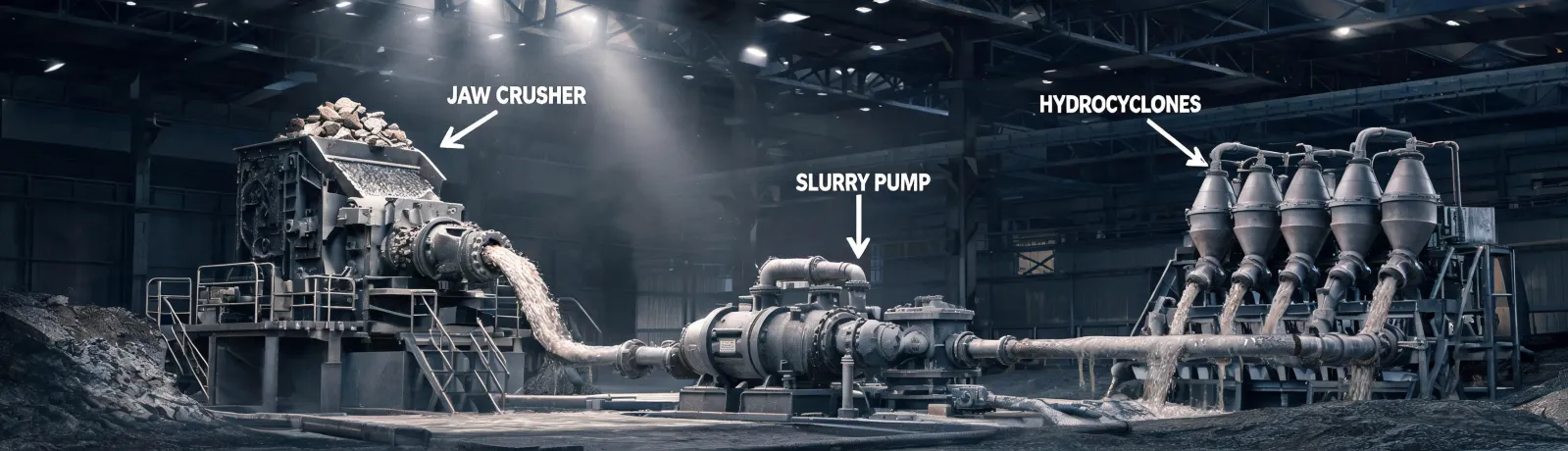
Imagine a critical part for a weir slurry pump at a mine site. The plant is scheduled for a 48-hour maintenance shutdown. If the part doesn't arrive, the shutdown is extended. That downtime costs the mine $X per hour—sometimes thousands.
I saved $150 on shipping by using a standard freight carrier for a weir parts order in September 2022. The truck broke down. The part arrived 36 hours late. The mine lost a full production day, and we had to pay a $1,200 premium for a partial reorder. The $150 'savings' cost us $1,350 plus a damaged client relationship.
The guarantee on the premium route isn't just paying for speed. You are buying insurance. You are saying, 'I do not want to roll the dice on my deadline.'
The Math That Changed My Mind
I started tracking this. In 2023, I logged 47 orders where we chose the budget option for time-critical items. Five of those (about 10%) caused significant delays—defined as causing a project to miss a hard deadline. The total 'savings' on those five orders was about $250. The total cost of the failures (rush reorders, lost bonuses, customer goodwill) was over $6,000. Net loss: $5,750.
The cheap option was a 10% gamble. That's a terrible bet when the stakes are high.
Dimension 2: The 'Rock Weir Design' of Your Schedule (Fragility)
Think of your project timeline like a rock weir design in a river. A properly built weir is robust. It has a wide base and is anchored. A fragile design—one that's too narrow—can be washed away by a small surge in the current.
A schedule built on 'probably on time' is a fragile rock weir. One supplier delay, one customs hold-up, one truck breakdown can wash away your entire plan.
A schedule built on guaranteed delivery is a robust rock weir. It has a buffer. The guarantee is the anchor. You know when it lands, so you can schedule your labor, your crane, your plate compactor crew for site prep, all with confidence.
I once ordered a special valve for a project. We had 4 days of buffer in the schedule. I thought, 'Plenty of time.' I chose the budget ground shipping. The package sat in a sorting facility for two days. The buffer was gone. We spent the last 48 hours in a panic, paying for Saturday overtime just to get the mustang truck to the site on time to retrieve the shipment. We made the deadline, but the stress and panic cost us more than the guaranteed delivery would have.
What I mean is: the cheap option introduces fragility into your entire plan. The premium option gives you a robust schedule.
Dimension 3: The 'Dough Scraper' Effect: Hidden Labor Costs
Here's a factor I used to ignore completely: the hidden labor cost of managing uncertainty.
What is a dough scraper in a bakery? It's a simple tool used for cleaning and moving dough. It's small, cheap, and unglamorous, but without it, the workflow stops and gets messy.
Tracking a non-guaranteed shipment is like being a dough scraper for a badly managed delivery. You are constantly checking tracking pages. You are calling the carrier. You are sending status update emails to your boss. 'Is it here yet? Where is it?'
I've tracked this. For one budget-shipped order, I personally spent 45 minutes across three days just finding out where the damn package was. At my internal cost, and the cost to my team's focus, that 45 minutes of 'dough scraping' cost us about $75 in lost productivity. And we had no power to speed things up.
With a guaranteed premium service, the tracking is reliable. The communication is proactive. The total time spent on logistics management drops to maybe 5 minutes total: an email confirmation and a delivery alert.
So the 'cheap' shipping cost me $50 in freight and $75 in internal labor to manage the anxiety. The 'expensive' shipping cost me $150 but saved me that $75 in hassle and a ton of worrying. The gap is much smaller than it first appears.
Dimension 4: Opportunity Cost (The Biggest One)
The final dimension, and the one that finally converted me, is opportunity cost. What could you be doing instead of worrying about a shipment?
In March 2024, we were ordering custom parts for a massive project. The deadline was non-negotiable—a $15,000 event depended on it. The shipping was $400 extra for rush delivery.
I didn't even hesitate. We paid the $400. The alternative wasn't just 'the shipping cost.' The alternative was a high probability of missing the event, which would have been a total loss of $15,000 plus a massive embarrassment.
I only believed in paying for certainty after ignoring that advice and losing that $15,000 event potential. I am not making that mistake again.
When to Choose Which: A Practical Guide
So, do I always pay the premium? No. I've learned to use a simple decision tree.
Choose the cheap & uncertain option when:
- The delivery date is a 'nice to have,' not a hard deadline.
- The cost of missing the deadline is low (e.g., stock replenishment).
- You have a significant schedule buffer (more than 2x the lead time).
- The item is non-critical to the main operation.
Choose the expensive & guaranteed option when:
- Missing the deadline has any financial consequence > 2x the shipping premium.
- The item is critical to a planned shutdown or event.
- Your schedule buffer is thin or non-existent.
- Your own labor cost to manage the shipment is high.
In my experience, if you are asking 'Should I pay for rush delivery?', the answer is almost always yes. The fact that you are even considering it means the deadline matters. And when the deadline matters, the price of uncertainty is always higher than the price of certainty.