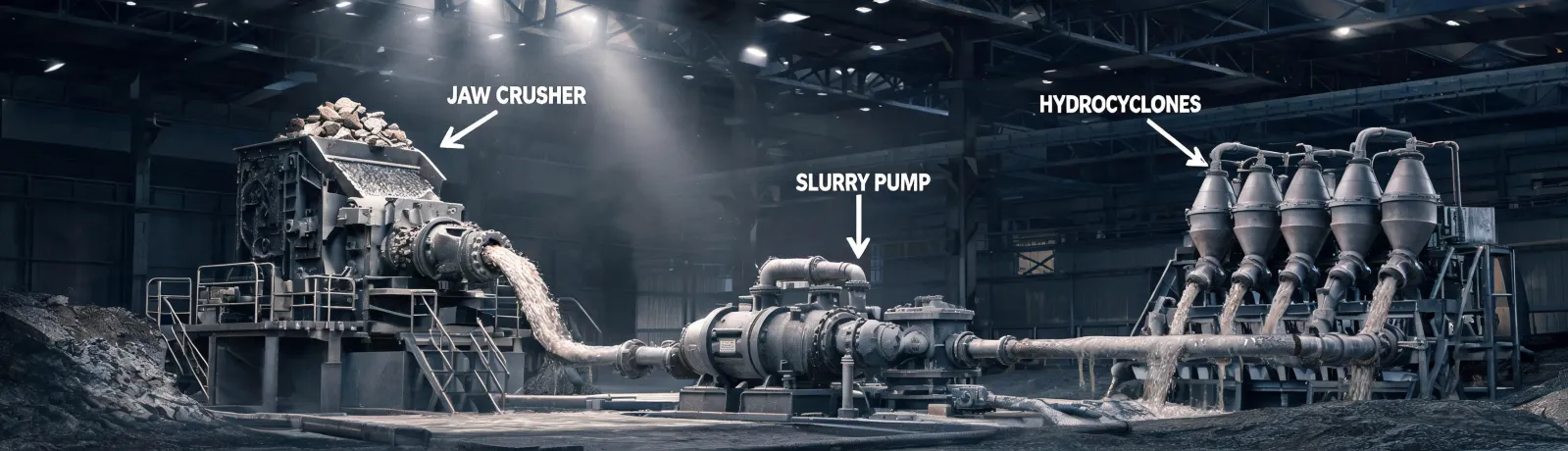
Disclaimer: I handle maintenance procurement for a copper mine. Been ordering Weir pumps and parts for 6 years. I've personally made about 17 significant mistakes—totaling roughly $48k in wasted budget. I now maintain our team's pre-order checklist. What follows are the questions I get most from new engineers. The answers include things I wish someone had told me in 2017.
1. What makes Weir slurry pumps different from a standard water pump?
People think a pump is a pump—just move fluid from A to B. Actually, slurry pumps handle solid particles in suspension. That changes everything. A water pump moving clear water at 60 psi will die in hours moving mill discharge. The difference isn't minor—it's fundamental metallurgy, impeller design, and wear liners.
Weir designs for abrasion and erosion. The Warman® line (which Weir owns) has thick elastomer liners, heavy-duty shaft seals, and impellers shaped to minimize particle impact velocity. A standard centrifugal pump might last weeks. A properly selected Weir pump can run years without rebuild. But only if you select correctly—which brings us to Question 2.
2. How do I select the right Weir pump model for my application?
First mistake I made (2018): I ordered a pump based on discharge head alone. Ignored solids concentration and particle size distribution. That pump clogged within 48 hours. Cost $3,200 to uninstall and return. Lesson: You need three data points—flow rate, total dynamic head, and slurry characteristics (specific gravity, particle size, solids by weight).
Never expected that a 20% increase in solids concentration could double the required horsepower. Turns out higher specific gravity demands way more power. The surprise wasn't the pump price—it was the motor and VFD upgrade we didn't budget for. The Weir selection software (SLURRY handling selection tool) accounts for this, but you have to input accurate data. Garbage in, garbage out. (Circa 2022, at least.)
Quick selection checklist (after I got burned):
- Solids specific gravity > 2.5? You need a heavy-duty pump (Warman® AH or HH series).
- Particle size > 8-10mm? Check the impeller passage size. Don't assume.
- pH below 4 or above 10? Verify elastomer compatibility with Weir's chemical resistance chart. (I learned this the hard way in September 2022—a $1,800 liner dissolved in 3 weeks.)
3. Are Weir OEM parts worth the premium over aftermarket?
The assumption is that OEM parts are just brand-name markup. The reality: aftermarket parts deliver inconsistent quality, which costs more in downtime. We tried a batch of aftermarket impellers in Q4 2023. Saved 40% per unit. Three of five failed within 3 months—the wear pattern was uneven, causing vibration and seal leaks. The redo cost (parts + labor + production loss) was $9,400. The OEM replacements (still running) cost $2,100. The math is simple.
That said, not every part needs OEM. We use aftermarket for non-critical applications—water handling, or low-wear transfer. But for high-wear slurry duty? OEM only. The consistency justifies the cost. (Based on our maintenance records, June 2024.)
4. How long do Weir slurry pump parts actually last?
Depends entirely on application. In our copper regrind circuit (hard particle, high velocity), a standard rubber liner lasts 6-8 months. In our tailings transfer (finer particles, lower velocity), same liner lasts 18-24 months. People ask for a number—I can't give one without knowing the wear index of the slurry.
Failed: I once ordered 12 spare impellers for a circuit we were decommissioning. (This was in 2021. I didn't check the mine plan.) Those impellers sat in inventory for 2 years. $5,400 sitting on a shelf, consuming storage space and cash. Now I order spares based on actual wear rates tracked over 6 months, not guesswork. The lesson: don't stock for hypothetical failure. Stock for projected wear.
5. Should I use a 'rock weir' or engineered structure for emergency slurry containment?
This is specific, but I get it. A 'rock weir' is a simple overflow structure made of rocks. Engineered weirs are designed with specific discharge coefficients and erosion protection. For temporary, low-flow situations (days, not months), a rock weir built with large riprap can work. For permanent or high-flow, you need engineered. I've seen rock weirs undermine and fail in a single storm event—the resulting uncontrolled discharge caused a regulatory issue. (That wasn't my mistake, but I documented it for our team.)
6. What about mixer selection for slurry tanks? (Also: People confuse 'mixer' with 'agitator').
People think a mixer and a slurry pump are related. They aren't directly, but both appear in mineral processing circuits. A 'mixer' for a tank (top-entry or side-entry) suspends solids to prevent settling. An 'agitator' might just move fluid. The confusion matters: ordering a mixer when you need a pump (or vice versa) wastes money and creates a process bottleneck.
A straight truck (not a pump, but I've seen engineers search this in the same procurement session) has nothing to do with slurry handling. But if you're ordering bulk materials delivery, a straight truck delivers dry bulk powders—which might go into a mix tank before slurry pumping. The connection: your feed system matters. If the mixer doesn't achieve full suspension, your pump will see fluctuating solids loading, which accelerates wear. It's all connected.
7. When should I pay extra for guaranteed delivery of Weir parts?
Had 2 hours to decide on a $400 rush fee for a critical pump seal in March 2024. Normal process: order standard shipping, wait 3-5 days. But we had a planned maintenance shutdown starting in 4 days. Missing that shutdown window = $15,000 in lost production opportunity from extended downtime. I paid the $400. The seal arrived in 2 days. The shutdown started on time.
The value of guaranteed turnaround isn't the speed—it's the certainty. After getting burned twice by 'probably on time' promises from aftermarket suppliers, we now budget for rush shipping on critical spares. Not for everything. But for items where delayed delivery means extended downtime, the premium is justified. The question isn't 'can we save $400?' It's 'what does missing the deadline cost?'
In hindsight, I should have identified those critical spares months earlier and ordered them on standard timeline. But with limited warehouse space and rotating stock, we can't predict every emergency. So we pay for certainty when it matters. It hurts—but less than a 6-hour emergency rebuild at 2am because the part didn't arrive.
Pricing as of January 2025; verify current rates with your Weir distributor. Individual results vary by application and operating conditions. I don't work for Weir. Just someone who's learned expensive lessons.