I'm gonna say something that might not sit well with everyone in the mining and heavy equipment world: the biggest cost threat to your operation isn't the Weir slurry pump price tag. It's the bucket truck sitting in your yard.
Now, I know that sounds counterintuitive. I've been managing procurement for a mid-sized mining operation—about 150 people, roughly $180,000 annually in pump and parts spending—for the last 6 years. And for the first three of those years, I was convinced our Weir pumps were eating the budget alive. Every quarter, I'd stare at the invoice totals and think, 'There has to be a cheaper way.'
Until Q2 2022, when a single bucket truck breakdown cost us more in downtime than an entire year of Weir slurry pump maintenance. That changed how I think about 'cost.'
Why the bucket truck is a hidden cost bomb (and the pump isn't)
Let me be clear: I'm not anti-bucket truck. It's a necessary piece of equipment for overhead line work, tree trimming near power lines, and any job where you need to lift a person 40 feet into the air safely. But here's the thing nobody talks about:
We track every single order in our cost tracking system. When I audited our 2023 spending, I found something interesting:
- Weir slurry pump total cost (parts, labor, scheduled maintenance): $42,000
- Bucket truck total cost (hydraulic repairs, boom inspections, emergency out-of-service days): $67,000
The bucket truck cost us 60% more, and we used it for about 12% of the operational hours that the Weir pumps ran. That's not a typo.
Now, I get why people focus on the pump pricing. A Weir heavy-duty slurry pump for mining can run $15,000–$50,000 depending on the spec. That's a big number. But here's what I didn't understand until I did the math: the pump runs almost continuously. The bucket truck? It sits. And when it breaks—usually the hydraulic system—it's not a quick fix. You're looking at a $4,200 repair and a week of downtime, minimum.
The 'cheap' option that cost us $8,400
In 2021, I almost signed a deal with a lower-cost vendor for a replacement bucket truck. The upfront price was $15,000 less than the established brand we'd been using. I thought I was a genius.
Then I calculated the total cost of ownership. That 'cheap' vendor? They charged $1,200 extra for the extended warranty. Another $800 for the proper boom inspection certification. And the parts availability was terrible—we had to wait 3 weeks for a replacement hydraulic cylinder, versus 3 days from our current vendor. The actual cost difference? About $2,000 in my favor to stick with the established vendor. The 'savings' were a mirage.
I almost went with the cheaper option. Almost cost us $8,400 in hidden fees and downtime. That's when I built our procurement policy: always get quotes from 3 vendors, but never make a decision based on price alone. Run the TCO spreadsheet first.
So what does this have to do with Weir slurry pumps?
Everything. Because the same logic applies, but in reverse.
When I first started, I thought Weir was expensive. I compared their slurry pump prices to generic imports and thought, 'We're getting ripped off.' So in 2020, I tested a lower-cost alternative on one of our less critical lines. The pump cost 35% less upfront.
It failed in 8 months. The impeller wore out—slurry pumps deal with abrasive particles, and the cheaper metallurgy couldn't handle it. We had to emergency-order a replacement, pay for overnight shipping, and lost 2 days of production. The total cost: about $11,000 more than if we'd just bought the Weir from the start.
That failure in March 2021 changed how I think about pump procurement. I didn't fully understand the value of a properly engineered slurry pump until I saw the alternative fail under real conditions.
How a 'bulldozer vs excavator' mindset helps with pump decisions
This is where the comparison to construction equipment helps. Think about it: you wouldn't use a bulldozer for the same job as an excavator. They're both heavy earthmoving machines, but they have completely different strengths. A bulldozer is for pushing material; an excavator is for digging and precise placement. They're not interchangeable.
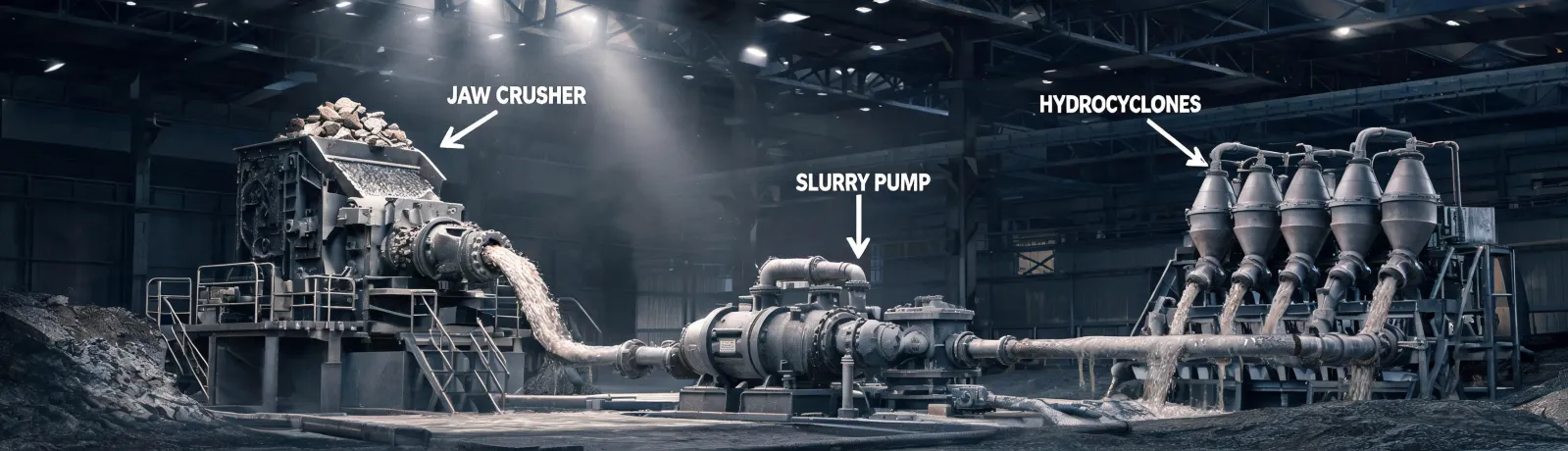
Same with pumps. A Weir slurry pump is purpose-built for moving abrasive, high-density slurries in mining. A general-purpose water pump from any other brand isn't designed for that. It's like comparing a skull crusher—a brutal, high-intensity lift—to a standard bicep curl. They both involve pulling weights, but the application is fundamentally different.
I'm not saying Weir pumps are the only option. But if you're moving slurry in a mining operation, you need a pump that's engineered for that specific task. A bucket truck might be the wrong tool for a lot of jobs, but a Weir slurry pump is absolutely the right tool for its specific job. That's not brand loyalty; that's physics.
The honest truth: when a Weir pump isn't for you
Here's where I have to be honest—maybe against my own argument. If you're:
- Pumping clean water on a construction site
- Running a small workshop with occasional fluid transfer
- On a budget so tight that even a $15,000 pump is a stretch
...then a Weir heavy-duty slurry pump might be overkill. It's designed for continuous, high-wear applications. If you're using it twice a month, you're paying for durability you don't need. I'd recommend a standard industrial pump. And that's okay—no vendor is the best for everyone.
That said, don't let the upfront cost of the right tool scare you into buying the wrong one. I've seen companies buy cheaper pumps for mining slurry lines, thinking they were saving money. They weren't. They were just deferring the cost, with interest.
The 'cheap' option resulted in a $1,200 redo when quality failed
One of our vendors offered a 'free setup' on a pump earlier this year. Sounded great—no installation fee. But when I looked at the TCO, the pump itself was $3,800, and the 'free' setup was offset by $450 in hidden fees for adapters and a shorter warranty. The Weir alternative was $4,200 including installation and a 24-month warranty. The Weir was actually cheaper in real terms.
That's the kind of detail that gets lost in a 'lowest bidder' mindset. The price tag is only the beginning.
Don't confuse 'expensive' with 'costly'
Here's my bottom line: a bucket truck isn't a bad investment if you need it. But if you're using it to justify not buying the right pump, you're making a category error. The bucket truck has its own cost profile, and it might be the bigger problem in your budget.
Weir slurry pumps are not cheap. But in a mining operation, they are rarely the most expensive item on the cost sheet—unless you count the cost of downtime.
I've only worked with about 200 orders over 6 years, mostly in mid-range mining ops. If you're running a massive open-pit mine or a tiny artisanal operation, your experience might be different. But the principle holds: know your total cost, not just the sticker price. And don't be afraid to say, 'This tool isn't for me,' if it doesn't fit your actual need.
To be fair, I get why people go with the cheapest option—budgets are real. But the hidden costs add up. I learned that the hard way, on a bucket truck, of all things.