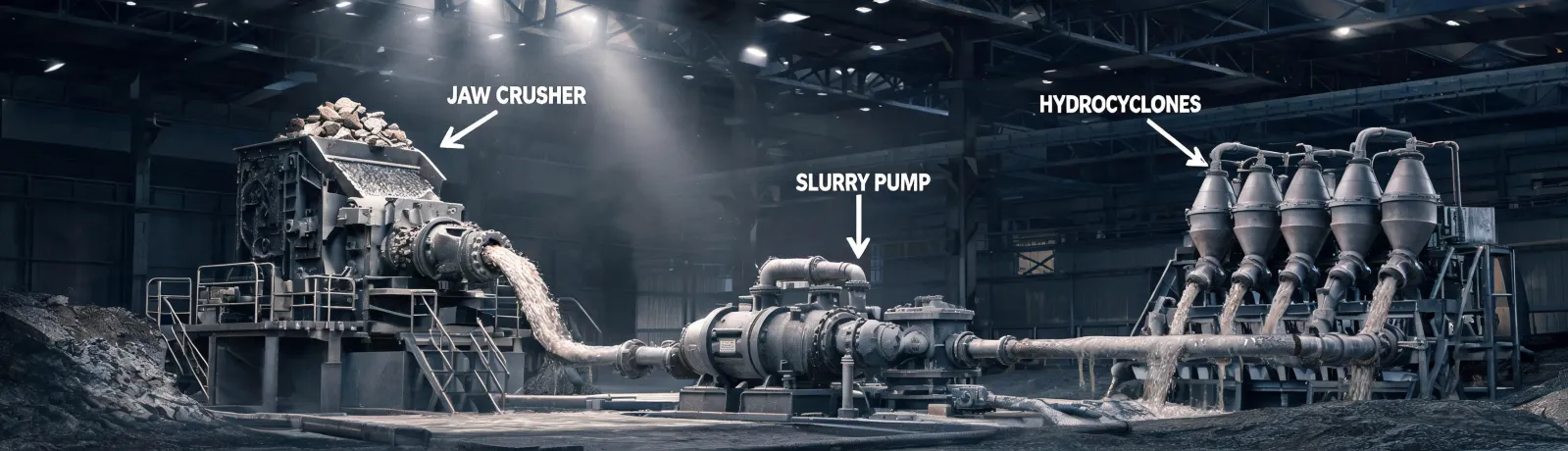
I manage purchasing for a mid-sized mining services contractor—roughly $2M annually across 15+ vendors. When I took over in 2021, I inherited a supplier list that included both Weir slurry pumps and standard water pumps from the same distributor. My first year taught me that assuming 'they all move fluid' is a rookie mistake that costs time and money.
Here's the thing: there is no universal answer. The right pump depends entirely on what you're moving, where you're moving it, and for how long. I've made the wrong call more than once, and those mistakes fall into three clear patterns.
Which scenario fits your situation?
- Scenario A: You're pumping abrasive slurry (mine tailings, heavy solids, sand).
- Scenario B: You need a general water pump (clean water, light debris, occasional use).
- Scenario C: You're on a tight budget and considering a 'one-size-fits-all' alternative.
Scenario A: The Slurry Job – When Only a Heavy-Duty Pump Will Do
If your application involves moving slurry—think mining waste, gravel wash water, or sludge from a processing plant—a standard centrifugal water pump is not an option. It's like using a sedan to haul concrete blocks. It might move them, but not for long.
In my experience, Weir slurry pumps are the go-to here. Their WARMAN® series, for example, is engineered for exactly this: thick, abrasive, high-density fluids (Source: Weir Minerals product literature, 2024). The key difference is the 'wetted end' design—the parts that touch the slurry. These pumps use liners and impellers made from wear-resistant materials (like high-chrome alloys or rubber), whereas general water pumps use standard steel or cast iron.
What I look for when specifying for slurry:
- Wear life: A Weir slurry pump can last 3-5 years in heavy use with proper maintenance. A standard pump in the same service might fail in 6 months (ugh).
- Sealing system: Slurry pumps need dynamic seals (like expeller or mechanical seals with a flush system). A standard pump's packing gland will fail from the grit.
- Parts availability: Weir has a global parts and service network (weirminerals.com). For a critical line, downtime is not an option. I've learned never to assume a generic pump part will fit after a project delay cost us $15,000 in downtime.
In Q3 2023, we replaced a competitor's general-purpose pump that had lasted only 8 months on our tailings pond. The Weir replacement cost 40% more upfront but is still running (note to self: track its actual lifespan and compare).
Scenario B: The Clean Water Job – When a Standard Pump is (Usually) Fine
If you're moving clean water—dewatering a pit, supplying a wash station, or circulating cooling water—a standard water pump is almost always the right choice. Most jobs don't need a $15,000 slurry pump to move rainwater.
Here's what I consider:
- Fluid characteristics: Clean water (less than 2% solids by weight) is fine for a standard pump. Once you hit 5%+ solids, you risk rapid wear.
- How long will it run? For temporary dewatering (a few days), a submersible utility pump is fine. For continuous service (24/7), you want a cast-iron bodied pump with a decent seal, like some of the Goulds or Grundfos lines. I've seen cheap plastic pumps fail in a week of continuous use (note to self: always spec cast iron for continuous duty).
- The GFCI breaker requirement: For any pump running in wet conditions in North America, you must use a GFCI-protected circuit. The National Electrical Code (NEC 2023) requires GFCI protection for all 120V, 15 and 20 amp receptacles in commercial settings. This isn't optional in our industry—our safety inspector checks for it.
"In our 2024 vendor consolidation project, I realized we had five different pump models for clean water applications. We standardized on one reliable vendor and saved 12% on maintenance costs. When exploring replacement options, I even looked into a replacement Weir door as a potential upgrade path for some older units."
Scenario C: The Temptation of the 'Universal' Pump
This is where I see people make the most expensive mistake. Someone finds a pump that claims to handle 'up to 50% solids' for half the price of a proper slurry pump. I almost fell for it in 2022. The vendor's website said it was for 'heavy-duty slurry,' but when the spec sheet arrived, the impeller was cast iron, not high-chrome alloy. What most people don't realize is that 'heavy-duty' is not a regulated term—it's a marketing claim.
Here's how I check for the universal pump trap:
- Ask for the specific material of the impeller and liner. If they can't tell you it's a specific wear-resistant alloy (like A05 or Cr27), run.
- Check the performance curve for slurry. A general pump curve is based on water (specific gravity 1.0). Slurry at 30% solids has a specific gravity of ~1.3. The required motor power increases by roughly that factor. If the vendor doesn't account for this, the motor will burn out.
- Ask about replacement parts. When I call a random supplier for a replacement impeller for their own 'universal' pump, and they say 'check eBay, ugh, that's a red flag. A reputable vendor will have a stated parts availability policy (Source: NPSA standards for pump reliability).
The honest, albeit annoying, answer is: if your fluid is abrasive, you need a pump that's designed for it. No short cuts. I've seen $10,000 in damage from using a light-duty pump in a heavy-duty application.
How to Determine Which Scenario You're In
If you're still unsure, here's my three-question checklist that I use for every pump purchase now:
- What is the fluid content by weight? More than 5% solids? You're in Scenario A. Less? Scenario B. Unknown? Test it or assume worst-case.
- Is the pump for continuous or intermittent duty? If it runs 8+ hours daily, do not cheap out on the bearings and seals.
- What is the cost of failure? If pump failure stops production or causes environmental harm, spend the money on a specialist pump from a brand like Weir. If it's a backup sump pump in a locker room, a standard pump is fine.
I've also learned to verify the vendor's parts availability. When I needed a specific Weir mining hose for an older WARMAN pump, the distributor actually stocked it. That's the kind of supply chain I need for a critical application.
Disclaimer: Prices and vendor quotes are as of early 2025. Always verify current pricing and product specifications directly with Weir Minerals or your authorized distributor.