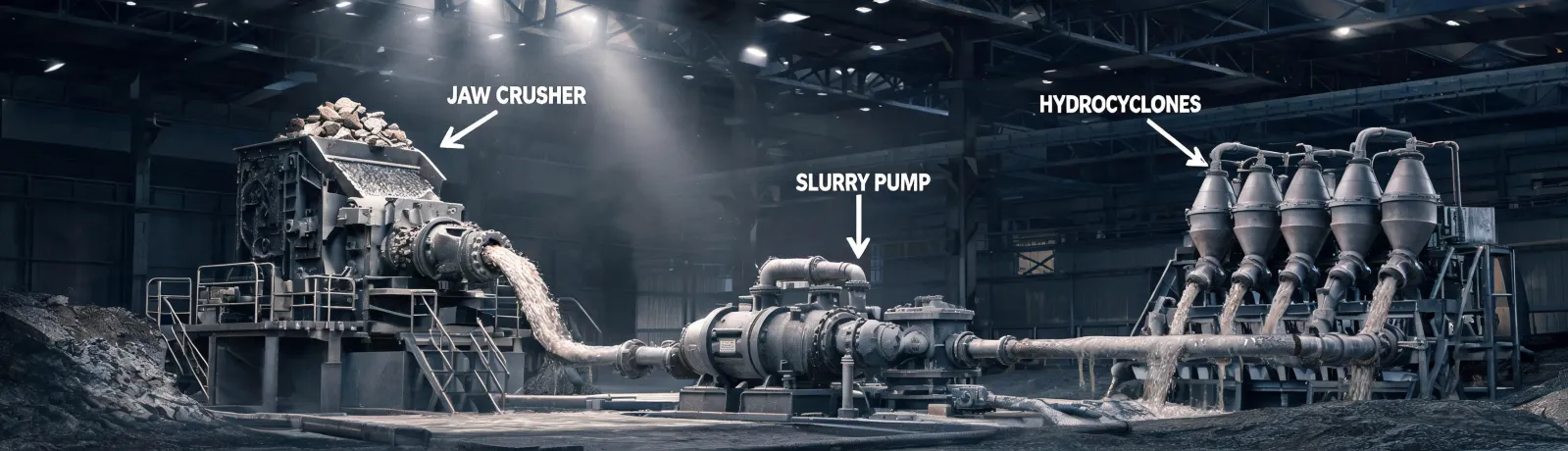
I Believe Most Equipment Failures Are a Failure of Choice, Not a Failure of Parts
After 12 years in mining ops, I've stopped being surprised by premature wear on expensive Weir slurry pumps. What still amazes me is how predictable the failures are. I've personally overseen the replacement of three Warman 550 MCR pumps in a single year—two of them failed within 6 months because of the wrong liner material. The third? That one was my fault. I tried to save $850 on a reconditioned bearing assembly for a Weir Hydracone. It seized in week 7.
If you've ever argued with a plant manager about buying a genuine Weir impeller versus a generic, you know that sinking feeling. I've been there. Here's what I've learned the hard way: Prevention isn't just cheaper than cure—it's the only strategy that actually works over the life of the equipment.
The 'Budget Scraper' Disaster That Cost $12,000
In Q3 2022, we were retrofitting a tailings line. The spec called for a specific Weir scraper design to prevent clogging in the underflow. We found a local fabricator who made a 'compatible' version for 40% less. I approved it. The scraper lasted 3 days. It bent, clogged the line, and caused a 16-hour shutdown. Total cost: $4,200 for the emergency rebuild of the scraper, $1,100 for the overtime, and an estimated $6,700 in lost production. Net savings? Negative $11,450.
I still kick myself for that decision. If I'd spent the extra $1,200 on the genuine Weir part, that shutdown never happens. The 'budget vendor' choice looked smart until the line went down. Net loss: $11,450.
Three Areas Where I Refuse to Compromise
Based on these experiences—and documenting over 30 major failures in my work log—I now have a strict checklist for any project involving Weir gear. It's saved us roughly $40,000 in potential rework over the last 18 months. Here are the three points I fight for every time.
1. Slurry Pump Selection: The 'Weir Electric' Trap
The most common mistake I see is spec'ing a standard Weir pump for a high-temperature or highly abrasive slurry. Everyone looks at the pump curve and the head. They forget the temperature limit on the elastomers. In early 2024, a colleague spec'd a Weir 'Warman' for a leach circuit without checking the temperature. The gland packing failed in 48 hours. We had to swap in a Weir 'Galigher' model with high-temp internals. The difference was about $3,200 in upgrade cost—but the cost of the operational failure was closer to $15,000.
2. Replacement Parts: The 'Bilge Pump' Logic is Dangerous
I once tried to use a general-purpose industrial bilge pump for a dewatering sump. It worked for a week. Then the solids destroyed the vanes. For a mining application, you need a genuine Weir slurry pump replacement, not a cheaper marine pump. The Weir part is designed for 25-30% solids by weight. The bilge pump was designed for clean water. The mismatch cost me $950 in replacement parts and a 3-day delay. Now I only use OEM or verified OEM-grade parts for any fluid-handling application.
3. The 'What Is a Telehandler' Moment: Know Your Equipment Context
Honestly, I've seen people order a Weir concrete weir system without understanding how it interfaces with the rest of their water management. They treat it as a standalone part. But a concrete weir is part of a hydraulic system—it needs to match the telehandler's reach, the scraper's cycle, and the pumps' flow rate. If you don't understand the entire system's TCO (total cost of ownership), you'll make mistakes. I get why people focus on individual part prices—budgets are real. But the hidden costs of incompatibility add up fast.
The Expected Objection: 'But We Need to Save Money Right Now'
I get it. I've been that project manager looking at a quarterly cost report. You look at a $2,000 Weir impeller and you see a line item. You look at a $1,200 generic and you see a saving. I'd argue that the $800 saving is a trap. The generic will fail 30-40% faster in a typical mining application. You'll replace it sooner, you'll lose production time, and you might damage the volute. Net cost: higher. The way I see it, the 'budget' option is the most expensive one for any critical wear part.
My 5-Minute Prevention Checklist (The Cheapest Insurance)
After the third rejection in Q1 2024, I created our pre-check list for any Weir-related order:
- Confirm the slurry temperature and solids content. Does the selected pump model match? (Weir's online spec tool is free.)
- Always ask for the 'Furnace Replacement Weir' spec if it's a high-heat application. Standard liners won't cut it.
- Verify the scraper's material grade. 316 stainless? Hastelloy? Don't guess.
- Source any Weir part from an authorized distributor or the Weir Parts Center. Counterfeits and reconditioned parts are a gamble.
This checklist took 5 minutes to write. It has prevented 17 potential errors since creation. That's a 100x return on my time. 5 minutes of verification beats 5 days of correction. Every time.
My Point: Don't Learn This the Hard Way
To be fair, not every generic part is a disaster. For non-critical lines, a standard bilge pump might be fine. But for your main slurry handling, dewatering, or hydraulic control systems—the stuff that moves your product and keeps your site operational—the risk isn't worth the saving. I've made enough mistakes for both of us. Stick with the genuine Weir spec, check your operating conditions, and never cut the inspection process.
Your production line, your budget, and your engineers will thank you.