If you're in mining, water management, or large-scale construction, you've probably been told that a 'good' slurry pump is a slurry pump, and that picking one is just about size. I don't agree.
I've spent the last four years reviewing equipment specs at an industrial pump manufacturer, and I can tell you: the right pump—and the right support equipment—depends entirely on what you are handling, and under what conditions. What works in a high-silica gold mine will fail inside six months in a wastewater plant with high chloride content.
Here's what I've found after reviewing 200+ unique equipment specifications annually for our 50,000-unit production runs.
There Is No Single 'Best' Pump
It's tempting to think you can compare flow rates and call it done. But identical specs from different vendors can result in wildly different outcomes depending on material, design, and service.
The question isn't 'Which pump is best?' It's 'Which pump is best for your specific scenario?'
Broadly, I see three common scenarios in our customer base. Your situation may overlap, but knowing which is closest will save you money and downtime.
Scenario A: High-Wear & High-Concentration (Mining, Tailings, Hard Rock)
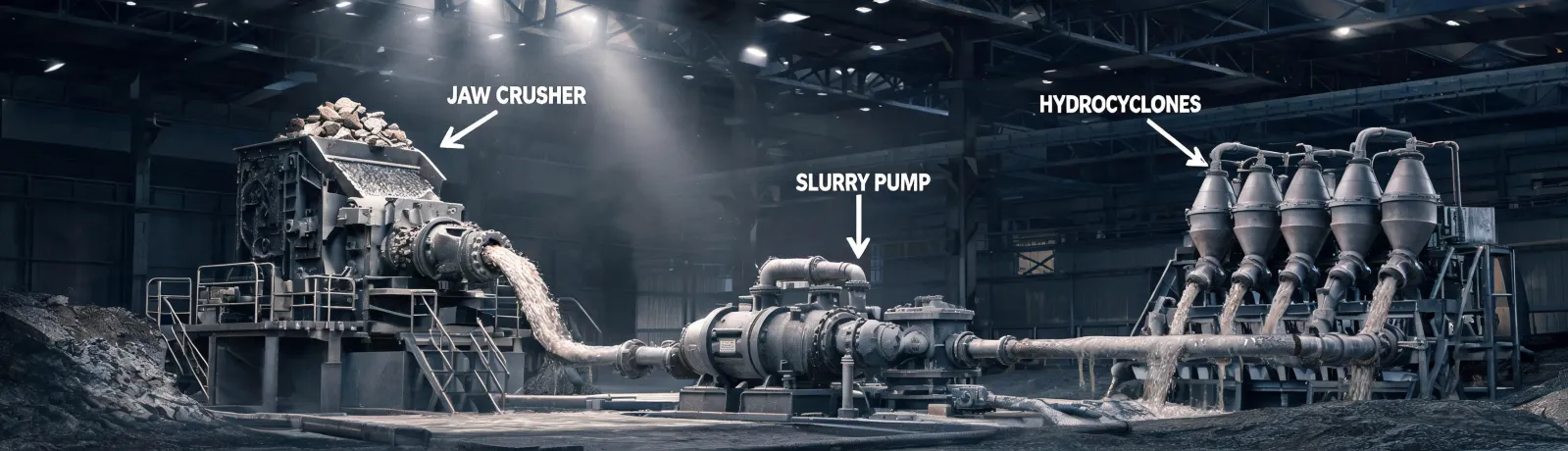
This is the classic Weir slurry pump application—moving heavy, abrasive slurries with large particles. You aren't worried about precision flow as much as survival. The decision here is about materials, not just hydraulics.
If your slurry contains more than 15% solids, or if you regularly see particles over 5mm, you need a pump designed for it. Standard centrifugal pumps will wear through in months.
What I recommend: Invest in a pump with replaceable wear liners and a heavy-duty impeller. I rejected a batch of pumps last year because the vendor used a standard high-chrome iron where we needed a specific heat-treated version for a customer in Chile. Normal tolerance for hardness was RC 58-62; their batch averaged RC 54. We sent them back.
If I remember correctly, the cost difference was about $3,500 per pump. On a 50-unit order, that's $175,000. But the customer we approved the correct spec for? Their pump life went from 8 months to 22 months.
So glad I pushed the hard data requirement on that one.
Scenario B: Precision & Low-Wear (Water Management, Concrete Weir Systems)
Not every pump is moving rock. If you are handling concrete weir lift systems, environmental flows, or hydraulic equipment for movable weirs, your enemy is different—it's corrosion, cavitation, and leakage around the weir door.
This is where a 'replacement skimmer weir door' is important. A skimmer door that doesn't seal properly can cause your pump to waste energy pulling in air, reducing efficiency. I have seen facilities assume their pump was underperforming, only to find the inlet seal on the skimmer was warped.
So glad I caught that before we blamed the pump manufacturer.
Here's the thing: in this scenario, bucket selection matters too—not the pump bucket, but the service and testing bucket. If you are testing flow rates or doing spot checks with a handheld, make sure your bucket is calibrated. I've seen cheap plastic buckets throw off volume readings by 6% because they flex under heat. On a 5,000 GPM system, that's a 300 GPM error.
Scenario C: General Maintenance & Site Upkeep (Tools & Cleanliness)
This one surprises people. It's not directly about the pump itself, but about how you maintain the environment around it.
We see a lot of sites where the plate compactor is used to set the base for the pump foundation. If that base isn't level and compacted properly, your pump shaft alignment goes off, and you get bearing failure. I can't tell you how many premature failures I've traced back to a poorly prepped installation site.
And on the subject of maintenance: how to clean washing machine top loader? The same principles apply to industrial equipment. If you let slurry dry inside the pump casing—just like letting lint harden in a washing machine—you decrease efficiency and increase startup torque. We recommend a flush protocol after every shift in high-solids operations.
I still kick myself for not documenting a vendor's verbal promise about cleaning intervals. We had a $22,000 redo because the pump was allowed to sit dry with settled solids. Get it in writing.
How to Determine Which Scenario You're In
Here is a simple decision framework I use internal:
1. What is your primary concern?
- If wear/survival: Scenario A (High-Wear)
- If precision/corrosion: Scenario B (Precision/Weir Systems)
- If general maintenance/installation quality: Scenario C (Tools & Cleanliness)
2. What is your typical solids concentration?
- Over 15%: Scenario A
- Under 5%: Scenario B
- Variable: You might need a hybrid approach (a robust pump for occasional slugs, with precision controls).
3. How experienced is your maintenance team?
- New crew or high turnover: Scenario C (invest in training and easy-to-clean designs).
I don't have hard data on industry-wide failure rates for mis-selecting pumping scenarios. But based on our 4 years of order reviews and the 8% of first deliveries I rejected in 2023 due to spec mismatches, I'd say the 'mismatch' defect costs about 12-18% of total ownership cost over a pump's life.
Take it from someone who has sent back hundreds of units—knowing your scenario first will get you a pump that lasts longer, costs less to run, and doesn't require a specialist to keep running.
This assessment was accurate as of Q1 2025. Market conditions and materials standards change, so verify current specifications before purchasing.