I've spent a dozen years sourcing equipment for mining, mineral processing, and water projects. In that time, I've placed more than 300 rush orders. And the phrase that makes me cringe every time is: “It’s just a pump.”
It’s not just a pump. The equipment you choose tells your customer who you are. Quality is brand perception.
Honestly, I didn't always think that way. But after a few expensive lessons, I changed my mind.
An emergency I won't forget
In March 2024, a mining contractor called at 3 p.m. on a Thursday. Their slurry pump had just lost its wet end, and the replacement liner and impeller they had in stock didn't fit. They had a prepaid rail car waiting at the mine loadout, and if the pump wasn't back online by Saturday morning, a $50,000 penalty kicked in. Normal lead time for those parts was five business days.
The easy answer was to tell them to take any pump they could find locally. But I'd made that mistake before. In my first year, I bought a cheaper alternative to save $400. It failed nine months later, and the rework cost us nearly $6,000—not counting the damage to the customer's confidence. Like most beginners, I approved a pump without a proper parts-availability check. I only made that mistake once.
So we found a vendor with the correct Weir Minerals slurry pump replacement parts, paid $780 in overnight freight, and had the pump running by 9:40 a.m. Saturday. The contractor's alternative was a misaligned temporary pump that would have slowed the entire milling circuit—right in front of their customer. At least, that's been my experience with deadline-critical mineral processing work.
I should add that we now have a formal verification checklist for replacement parts. We didn't have one before that incident. A simple checklist would have caught the mismatch in an hour.
How does a water pump work? The basics actually matter
Before you spend money on any pump, it helps to understand what it's doing. How does a water pump work? At its most basic, it creates a pressure difference. The pump lowers pressure at the inlet, the fluid outside pushes in, an impeller or diaphragm moves the fluid, and the discharge side directs it where it needs to go.
You've used this principle dozens of times. An air pump and a balloon pump both work the same way: expanding a chamber creates suction, squeezing it forces fluid out. Simple enough.
According to the U.S. Department of Energy (energy.gov), pumping systems account for nearly 20% of the world's electrical energy demand. But the percentage that matters more on a mine site is the one that fails when you guessed wrong.
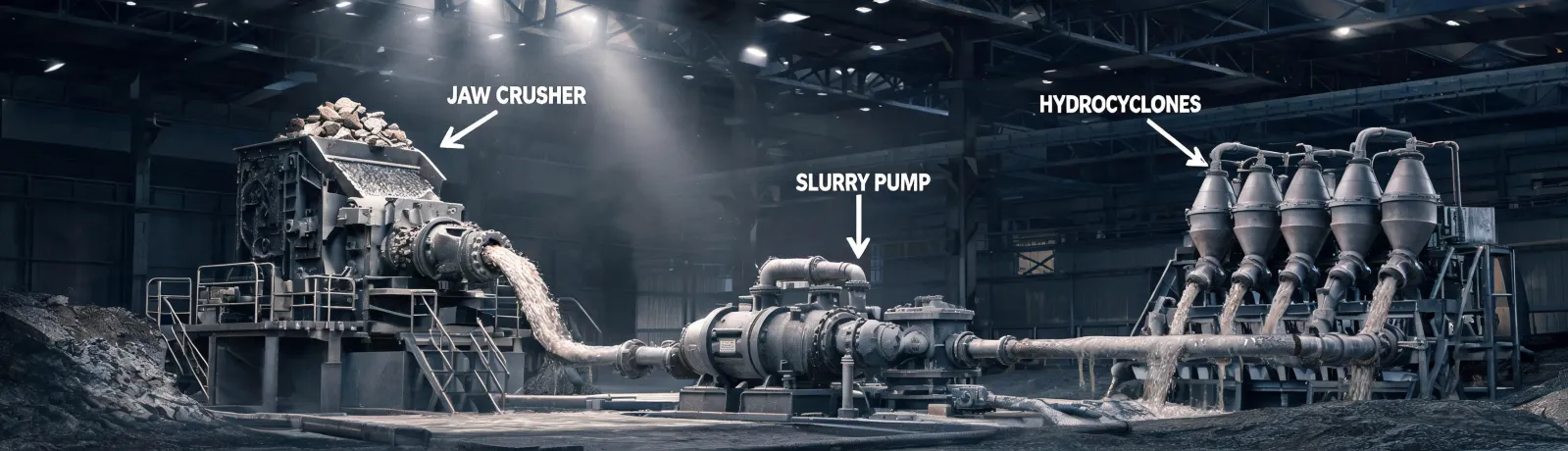
Now imagine the fluid isn't air or water. It's slurry—water mixed with rock particles, abrasive sand, and chemical residue. Every impeller pass is like rubbing the pump with sandpaper. A pump designed for clean water doesn't survive long in that environment. That's why slurry pumps use thicker casings, wear-resistant liners, and impeller clearances that can be adjusted as parts wear.
This is where brands stop being just names. A company that has engineered and documented a slurry pump for years will give you very different advice from a supplier that simply imports a generic pump and gives it a paint job.
Weir Minerals slurry pumps: the quality argument
I'll be direct: I've specified Weir Minerals slurry pumps on several projects. They're rarely the cheapest quote. But in my experience, they provide two things that matter more than price in an emergency: predictability and support.
Predictability matters because when you're down, you don't need a manufacturer to “try” something. You need to know the part will fit and will handle the duty. Weir Minerals can tell you exactly which impeller, liner, and shaft seal to use for your solids content and flow. That's not just a service; it's a lifesaver.
Support matters because even good pumps wear out. I can't count how many times a distributor's willingness to answer a phone after hours saved a whole month of schedule. When a client asks me who is behind this pump, the answer should include real people with real spare parts, not just a product catalog page.
Here's the counterintuitive part: quality is even more important in an emergency. When your line is down, there is no time for trial-and-error experiments. A premium product is actually the lower-risk option because its failure patterns are known.
What's in a name? Ask a weir
Search the word weir, and you'll find a low dam that controls water flow. Search a little longer and you'll see a global engineering group that builds pumps and valves. You might also notice the Candace King Weir Foundation in a separate context. Context matters, but so does reputation. A name is a promise you make before you've shown anyone the spec sheet.
When I see a Weir Minerals slurry pump on a mine site, I don't assume it's indestructible. But I do assume the manufacturer has spent years understanding water, wear, and pressure. That's the same reason people trust a well-designed weir to keep a river predictable. Both are examples of engineering that respects the physics.
Your customers won't read your pump supplier's brochure. They'll just see whether your process runs consistently. That's why quality isn't an internal detail—it's a public statement about your standards.
What about the budget?
I know budgets are real. I've had to justify rush freight, and I've lost a contract because I tried to save money on the wrong part. That experience taught me a simple rule: never let the purchase price be the only number in the decision.
Let's say a generic slurry pump costs $4,000 less than a Weir Minerals unit. If the generic pump runs for 12 months and the branded pump runs for 36 months on the same duty, the generic pump isn't cheaper. It's a subscription to premature failure. Add in downtime, lost production, and the awkward conversation with your own customer, and the savings evaporate.
Does this mean every cheap pump is bad? No. A simple air pump or a balloon pump for a party has no business wearing a premium brand. For light-duty transfer of clean water, a lower-cost pump might be perfectly rational. But if the pump is part of a process with consequences, buy the quality that fits the consequence.
This was accurate as of early 2025. Market conditions change, so verify current lead times and warranties from your local distributor before committing.
My opinion, restated
I'd argue that quality is not a nicety. It's the cheapest insurance against brand damage you can buy. You can cut corners on cafeterias, company trucks, or office furniture. But when a slurry pump sits between you and your customer's deadline, that pump isn't equipment—it's your reputation with a discharge flange.
The next time someone tells you to “just find any pump,” remember what a pump actually does. It creates pressure. The right pump creates the kind of pressure your team and your customer need: the confidence that the process won't stop.
That confidence is the brand. Protect it.