There's No Single 'Right' Answer for Weir Parts Sourcing
If you've ever had to approve a purchase order for Weir equipment or replacement parts—whether it's a slurry pump impeller, a pool weir door assembly, or a seal kit for a movable weir hydraulic cylinder—you've felt the tension. The OEM part is expensive. The aftermarket option looks like a deal. And the used market? Even cheaper.
Here's what I didn't understand when I first started managing our procurement budget six years ago: the cheapest quote is rarely the cheapest part in the long run.
My initial approach was to go with the lowest-priced supplier for every order. I figured, 'It's just a piece of metal or rubber—how different can it be?' After three budget overruns caused by premature failures, I learned to look at the full total cost of ownership (TCO). That shift in thinking saved my department about $8,400 annually—roughly 17% of our parts budget.
So, how do you decide when to pay for OEM Weir parts and when you can safely save? It depends entirely on three factors: criticality, system complexity, and your maintenance crew's capability. Let's walk through the scenarios.
Scenario A: Critical, High-Interfacing Components (Go OEM)
This is the most expensive scenario, and it's also the one where going cheap hurts the most. I'm talking about components that, if they fail, stop the entire production line or cause secondary damage.
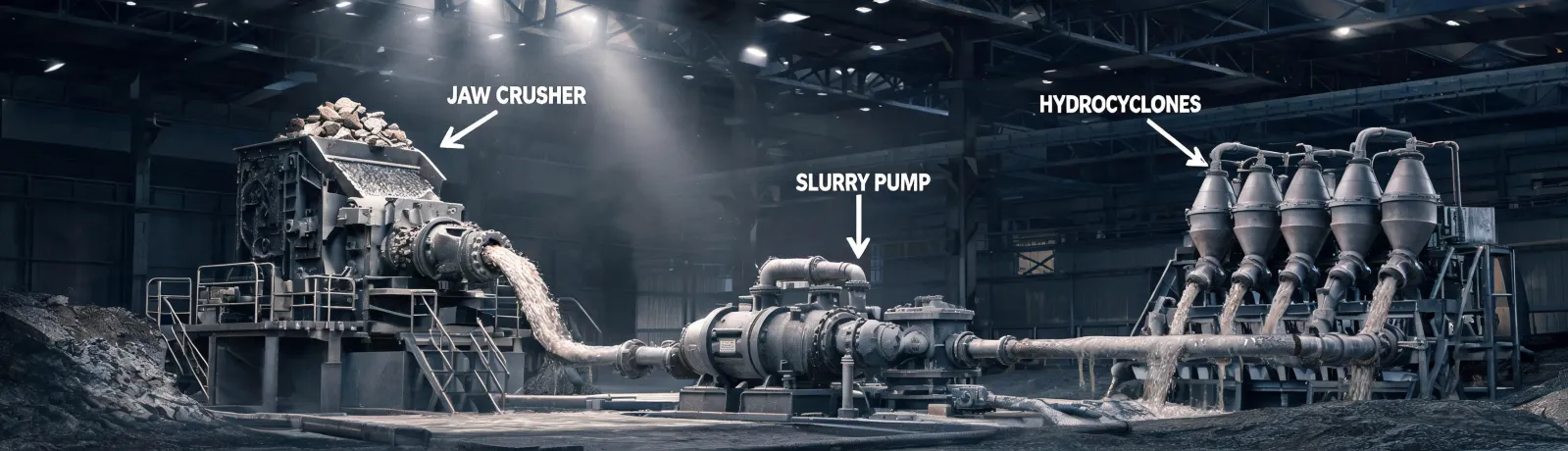
- Examples: Slurry pump wear plates, impellers for high-head applications, main shaft seals on a weir minerals slurry pump, and hydraulic cylinders for weir gate control.
- Risk of aftermarket: You might save 30-40% on the part price, but if the geometry is off by a millimeter or the metallurgy is slightly different, you could see premature wear, increased power consumption, or catastrophic failure.
I only believed this rule of thumb after ignoring it. Back in Q3 2023, we sourced an aftermarket impeller for one of our primary dewatering pumps. It looked identical. It cost 40% less than the Weir part. Six weeks later, it had eroded unevenly, causing severe vibration that damaged the bearing housing. The total repair cost: about $4,200—far more than the $600 we saved on the impeller. (Here's something vendors won't tell you: the dimensional tolerances on Weir's own castings are tighter than most aftermarket shops can achieve, especially for proprietary alloys.)
Scenario B: 'Consumable' Wear Parts in Low-Risk Loops (Non-OEM is Fine)
This is the opposite scenario. For parts that wear out on a predictable schedule, that are easy to replace, and where a failure doesn't cause secondary damage, non-OEM parts are often the better financial move.
- Examples: Rubber hoses in less abrasive service, standard gaskets, some pool skimmer weir replacement parts, and basic seal kits for low-pressure applications.
- Why it works: These are commodity-like items. The risk of a failure is just having to replace it a little sooner—it doesn't take down the operation.
We switched our generic hose supplier in Q4 2024 and saved about $2,500 on that category alone. The hoses might last 10% less time, but the savings more than make up for it. To be fair, we only did this after we implemented a more rigorous inspection schedule (checking hoses every two weeks instead of monthly). It's a trade-off: you save money on parts, but you spend more on inspection labor.
Scenario C: Mixed Systems (The 'Decision Tree' Approach)
This is the reality for most industrial operations. You have a concrete weir system from the 1990s with a mix of Weir parts and legacy components. Or you're maintaining a Westinghouse generator where the pump is a Weir unit. In this case, a hybrid strategy works best.
Here's a rule I use from our cost tracking spreadsheet: If the part's failure could cause a shutdown longer than 4 hours, or if its replacement requires a specialist, buy OEM. If it's a simple swap, buy the best value.
For example, in our weir parts center inventory, we stock OEM impellers, but we use generic V-belts and basic bolts throughout. That single decision—splitting the buy—has kept our average part cost down without increasing downtime. The most frustrating part of this approach is the admin overhead (tracking two separate vendor lists). But after the fifth time we had to scramble for an emergency part (ugh), it's worth it.
How to Figure Out Which Scenario You're In
Here's my practical guide for deciding, based on the 8 vendor comparison spreadsheets I've built over the years:
- Calculate the cost of downtime. If it's a water pump cooling a critical process, that's scenario A. If it's a drainage pump on an auxiliary line, that's scenario B.
- Ask your maintenance team a specific question: 'If this part fails, will I need engineering to fix it, or just a mechanic?' Engineering involvement = scenario A.
- Check the Weir part number. If it's a standard metric part (like a common bearing or seal), it's probably fine generic. If it's a custom casting with Weir's trademark, stick with OEM.
- Look at your failure history. We keep a log in our cost tracking system (as of January 2025). If you've had a failure on this specific part before, that's a sign to upgrade to OEM.
There's no single answer for every part. But by categorizing your purchases into these three buckets, you'll stop overpaying for low-risk items and stop taking dangerous shortcuts on critical ones. I've been managing this balance for six years, and it's the single biggest cost saver we've found.