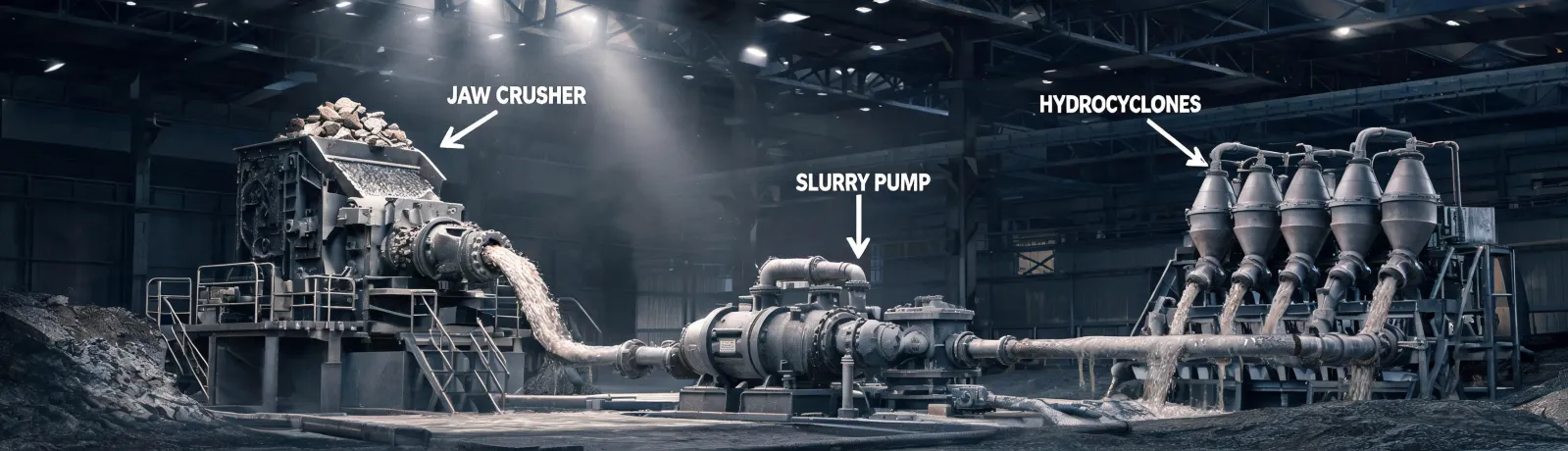
Since 2020, I've been the office administrator who buys everything from business cards to slurry pump parts. I process 60-80 orders a year, and I've learned that a product name can be the most dangerous piece of information in a procurement request. My first 'quick search' for a replacement slurry pump took two hours and solved nothing. I typed the word weir into our portal because that's what the engineer wrote on the request. Google didn't know if I meant the mining pump brand, a low dam in a creek, or a film by Peter Weir—Picnic at Hanging Rock. I got film reviews, pond construction tutorials, and irrigation advice. The actual pump part appeared somewhere after page 14. That was the day I learned a hard lesson: a name is not a specification.
The surface problem: a word that means too many things
Part of the mess is simple language. 'Weir' is a common noun for a small overflow dam. It's also the name of a global engineering group. Ask for weir mining and you'll get a little closer to the right place—the mining division, formally Weir Minerals, is the slurry pumping side of the business. But even that is a broad category. Weir Minerals doesn't make one 'weir pump'; it makes dozens of pump families: heavy-duty slurry pumps, dewatering pumps, piston diaphragm pumps. Saying you need a 'Weir pump' is like asking for a 'Ford' when you actually need a specific chassis with a utility body.
Why does this matter? Because the same problem repeats across every industrial category I buy. A bucket truck is not a bucket on a truck. It's a specific access machine defined by working height, horizontal reach, platform capacity, and whether the boom is insulated. A colleague once asked me to rent one for a stadium lighting job. When I asked how high the fixture point was, he said, 'Just get the tall one.' The tall one. That's how you rent a 60-foot unit for a 42-foot job and pay 50% more than necessary.
Agricultural equipment is no better. Tractor data sounds like a spreadsheet, but it's the difference between a pump that works for years and one that shakes itself apart in a season. A customer once told me he needed a PTO-driven pump for his tractor. I asked for the tractor's PTO horsepower, operating RPM, and hydraulic flow. He asked why I needed that. Because a pump sized for the wrong speed won't deliver the rated flow—and the impeller will eat cavitation damage before harvest. The product name is the beginning of the conversation, not the end.
The deeper problem: vague names hide vague suppliers
Here's something vendors won't tell you: a vague request is an opportunity. When you ask for 'the one that fits,' a supplier can quote the part they think you need. If it's wrong, the project pays the difference—in return fees, downtime, and a second freight bill.
This isn't malicious. It's the normal result of selling products for decades without correcting the customer's shorthand. A pump that pumps slurry is called a slurry pump. A part that fits a Weir pump often gets called a 'weir part.' The supplier hears the brand, confirms their inventory, and skips the engineering details. That's fine if the spec is simple. For a mining pump handling 60% solids, simple is a myth.
One of my first purchasing mistakes made this obvious. I found a vendor who quoted a great price for what I thought was the right wear ring. The order was placed, the invoice came with a handwritten note, and $2,400 disappeared from the department budget when finance rejected the expense report. The vendor wasn't trying to steal from me. They were comfortable operating at a very low level of friction—no proper invoicing, no spec sheet, no follow-up. The friction showed up exactly when I didn't want it: after the money was gone.
The real cost of guessing
In industrial work, a wrong guess doesn't just waste money. It wastes time, and time is measured in production and safety. Consider a dewatering pump that fails in a mine sump. If I ordered it without specifying solids content, particle size, or head pressure, the pump might run—for two weeks. Then the seals wash out, the shaft wears, and the line stops. The engineer who asked for a 'weir mining pump' when he meant a specific model sees a shutdown he didn't budget for. The vendor who delivered it sees a warranty claim he doesn't want. I see a lesson.
There's a useful parallel in auto repair. If you search 'how to tell if fuel pump is bad', you'll land on lists of symptoms: whining noise, long crank, cold-start stumble, weak acceleration. Those lists are helpful, but they only get you to a hypothesis. A competent mechanic doesn't replace the fuel pump because the truck cranked slowly. They check fuel pressure, test the relay, and measure voltage at the connector. They verify the data before they change the part.
Industrial buying works the same way. The data is the diagnosis. Without it, you're not buying a pump, a bucket truck, or a tractor-mounted unit—you're buying an expensive guess.
Boundaries are a sign of expertise
This is why I've come to value a supplier who will draw a line. In 2024, during a vendor consolidation project, I asked a supplier if they could handle a specialized elastomer repair outside their core line. Instead of promising they could, they said: 'This isn't our strength. Here are three companies that do it better.' That answer sounded odd at first. I'd rarely heard a vendor turn down revenue. But that exact statement earned my trust for everything else they do.
Personally, I'd rather work with a specialist who knows their limits than a generalist who overpromises. 'What can we do' should have an honest answer, not a list of everything the market sells. If a vendor says 'we can do it all,' I assume they've never tested 'all.' I ask for one specific detail—a performance curve, a reference installation, a copy of the acceptance test—and see how fast they deliver it.
This is also why I put a premium on documentation. When I order a printed brochure for our parts center, I don't say 'make it look professional.' I specify 300 DPI at final size—the industry standard for commercial offset—plus paper weight in gsm and a Pantone reference for the logo. A print vendor who pushes back with a proof is showing me they understand the job. A vendor who says 'whatever you want' will usually make me regret it. The same logic applies when I ask a pump supplier for the pump curve. I want test data, not adjectives.
Pricing is part of the boundary. In online printing, a next-business-day rush typically costs 50-100% more than standard turnaround, based on publicly listed online printer fee structures in 2025. I don't object to the premium; I object to surprise premiums. The vendor who tells me the markup before the order is showing the same transparency I want from a pump supplier.
The lesson
The next time someone asks me to buy 'a weir' or 'a bucket truck' or 'a pump for my tractor,' I don't search for the noun. I ask for the details.
That habit started with a two-hour search for a slurry pump that ended in a film archive. It was reinforced by a $2,400 invoice, a dead dewatering line, and the quiet patience of a vendor who told me what they couldn't do. The words 'weir', 'Peter Weir's Picnic at Hanging Rock', and 'weir mining' all live in the same dictionary, but they're not the same request. The only way to get the right answer is to ask the right question—and demand the right data.