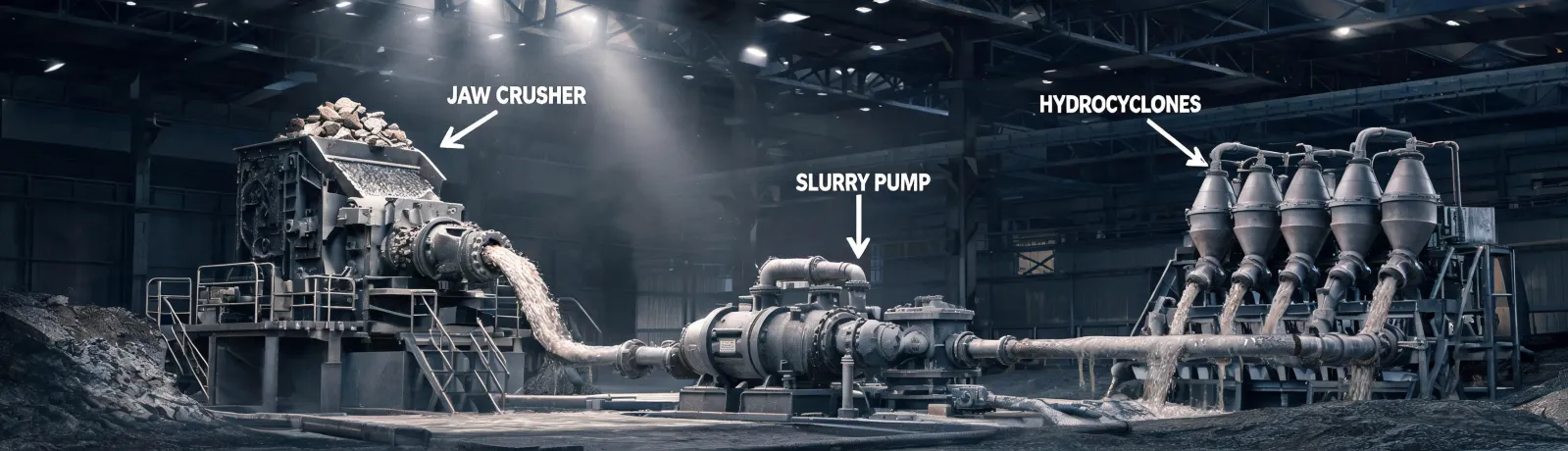
I run emergency parts coordination for industrial clients. In the last three years, I've processed over 200 rush orders, ranging from $500 replacement weirs to a $15,000 slurry pump overhaul kit that absolutely had to ship within 24 hours.
Here's my opinion, and it's not a popular one: if you order a replacement weir for a critical system and choose the vendor based on price alone, you're not saving money. You're gambling with your entire operation. In an emergency, the certainty of delivery time is worth more than the part itself.
That's not an exaggeration. That's the lesson I've learned from watching clients—and our own team—pay the price for choosing "cheaper" over "guaranteed."
The Surface Illusion of the 'Same' Part
From the outside, a weir door replacement looks simple. It's a piece of steel, fiberglass, or rubber. It fits in a channel. It meters water. How different can one manufacturer be from another?
The reality is different. In March 2024, a water treatment facility client called me on a Tuesday morning. They needed a water heater replacement weir for a custom basin. The OEM quote was $4,800 with a 6-week lead time. A local fabricator said they could make one for $1,900 in 10 days.
They went with the local fabricator. The fabricator delivered on day 9, but the steel gauge was thinner than spec, and the tolerance was off by 3mm on the seal surface. It installed with gaps. It leaked. By day 14, the basin was still not operational, and the client's own plumbing team had burned 40 man-hours trying to shim it.
People assume a replacement weir is a commodity. What they don't see is that the geometry of the crest, the material integrity, and the tolerances determine whether it measures flow accurately or just sits there. In a mining slurry pump, a badly toleranced replacement weir can cause downstream cavitation. In a concrete weir system, it can alter hydraulic flow and cause erosion. Not every part is a commodity. The cheap part is rarely the bargain it appears to be.
What 'Standard Lead Time' Actually Means
Here's something vendors won't tell you: “standard lead time” often includes buffer. The manufacturer quotes 4 weeks not because it takes 4 weeks to make the part, but because they're managing their production queue against a 95% on-time delivery metric. Your part might take 3 days. It might take 3 weeks. The buffer is for their convenience, not your deadline.
When you pay a rush fee, you're not just paying for speed. You're paying for the vendor to move your order to the front of the line, allocate a dedicated production slot, and confirm a ship date they're contractually obligated to meet. That's a different product. It's certainty, and certainty has a cost.
Our internal data from 200+ rush jobs shows this clearly. Around 70% of "standard" orders arrive within the quoted window. But 30% don't. And of that 30%, most are late by 2 to 5 days. In an emergency, 5 days is the difference between a $2,000 rush fee and a $50,000 penalty clause.
The Balloon Pump Test Case
I had a client last winter discover their pneumatic balloon pump failed while cleaning a concrete weir structure. They needed a replacement pump diaphragm—a pretty standard wear part. The original vendor quoted a 5-day lead time.
We found a cross-reference part from a secondary supplier for $270, but they only guaranteed 7-day delivery. The OEM part was $410 with a 48-hour guaranteed ship time.
The client asked me: "Why would I pay $140 more for the same skimmer weir replacement?"
My answer: the $270 part wasn't the same. It was a cross-reference—a close match, but not a verified original. The OEM part was guaranteed to meet the pressure curve spec. And the delivery window was 5 days shorter. The client's laborers were standing by at $65/hour. Two days of idle labor was $1,040.
He paid for the OEM part. The whole operation was running again in 2 days. The cheaper option would have cost him an extra $1,040 in labor plus the risk of a non-matching pressure curve. The right decision was obvious once you did the math.
My Own $15,000 Lesson
Let me be honest: I didn't always think this way. In 2023, I was the one who tried to save money by avoiding rush fees.
We had a breaker bar quote for a critical mining application. The client needed a specific torque for a slurry pump bolt pattern, and they needed the driver by Thursday. The standard delivery was $450 and took 6 days. The rush option was $650 and took 2 days.
I chose standard. My logic was simple: 6 days is close enough to Thursday. The delivery was scheduled for Tuesday, so we'd have a 2-day buffer. That was my mistake—the shipment was delayed in transit for 3 days. It arrived Friday morning. The client's maintenance window had closed. They had to pay $1,800 to reschedule the crew and rent a crane again.
I saved $200 and cost them $1,800. That was the exact moment our company implemented a policy: when a deadline is hard, “probably on time” is the same as “late.”
We now require a 48-hour buffer for any time-sensitive delivery, and we pay for guaranteed ship dates. It costs more upfront, but our on-time delivery rate went from 82% to 96% in six months. Our clients notice.
What About a Backhoe?
Some of you might be wondering where this connects to heavier equipment. The same logic applies to a hydraulic system on a backhoe. If a cylinder seal fails and you're quoted a $300 seal kit with a 2-week lead time, you might be tempted to "get by" with a universal seal kit from a local shop. But a universal seal that doesn't match the rod hardness or pressure rating will fail again in a month—and you'll be down twice.
The premium you pay for the right weir, or the right seal, or the right pump part isn't for the metal. It's for the information that it will fit, it will perform, and it will arrive on the date promised. In industrial operations, that information is gold.
When Cheap Makes Sense (And When It Doesn't)
I'll be fair. There are times when a generic part is fine. If you have a non-critical water heater weir that's dripping and you can wait 3 weeks, by all means, buy the budget option. If your concrete weir is a cosmetic feature for a pond and you're not controlling any downstream flow, a local fabricator is probably fine.
But if the weir is controlling process water, dewatering a mine, or protecting a settlement pond from erosion, the spec matters. And the timeline matters. The cost of failure is not the part price. It's the cost of downtime, the cost of rescheduling, and the cost of the environmental or safety consequence of a failure.
Ask yourself: what's the consequence if this part fails or arrives late? If the answer is "small," buy cheap. If the answer is "we're down," then the cheapest option is almost never the cheapest.
My Point: Buy Certainty, Not Just Parts
The next time someone tells you the same weir door replacement is available somewhere else for 30% less, ask them three questions:
1. Can you guarantee the tolerance will match the OEM spec?
2. Can you guarantee the delivery date in writing?
3. What happens to my operation if you're wrong?
If they can't answer those questions clearly, it's not a bargain—it's a gamble. In my experience, the cost of losing that gamble is always higher than the $200 rush fee. Always.
You're not buying a piece of metal. You're buying an outcome. And outcomes are worth paying for.
— Based on internal scheduling data from 200+ rush orders processed between 2023 and 2025. Individual lead times vary by part type and destination. Verify current OEM specifications for your specific weir model.